







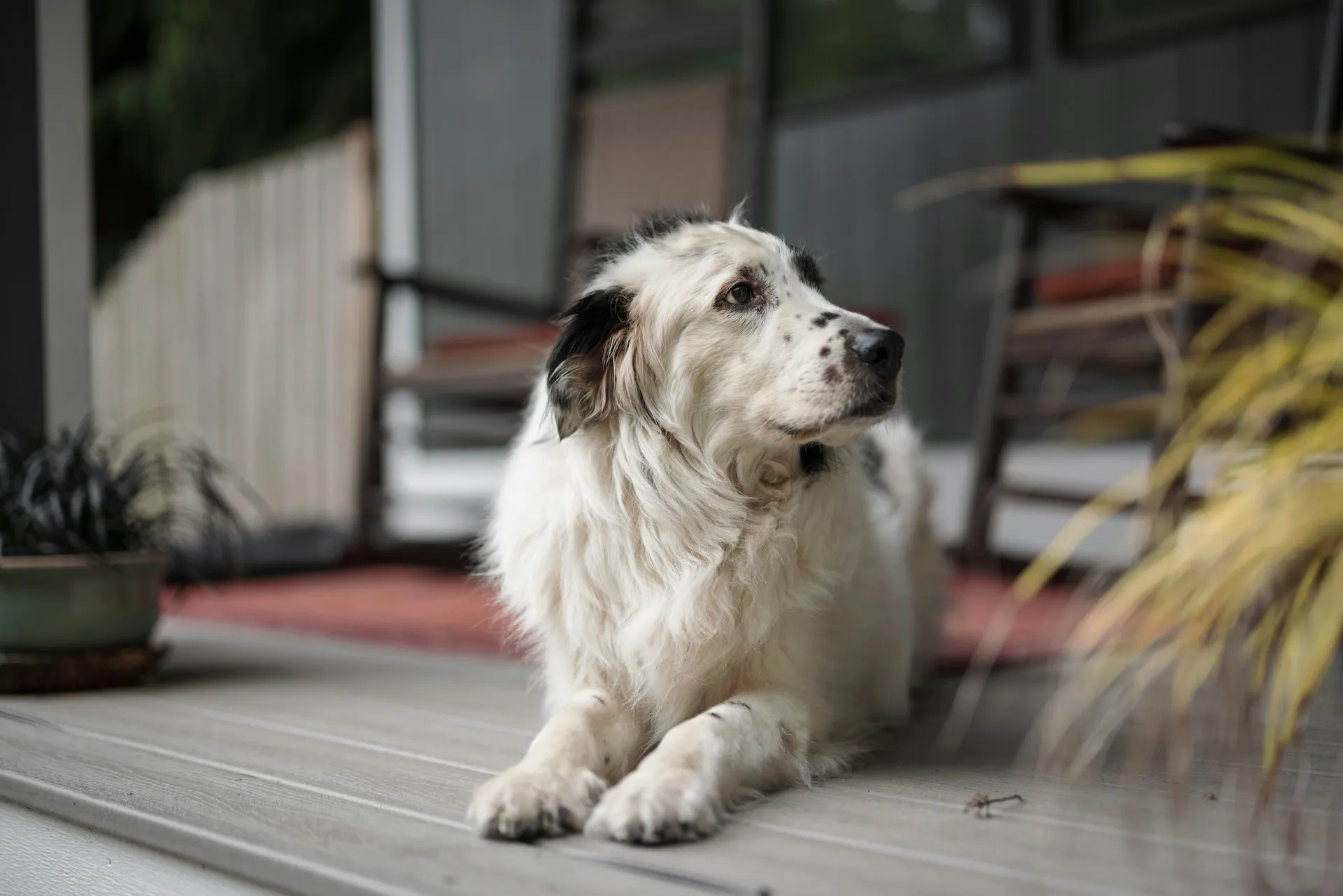
Old dog vestibular disease is a sudden problem with balance in older dogs. A dog who seemed fine earlier may tilt their head, fall, or circle to one side, and their eyes may flick back and forth on their own. Some also drool, vomit, or won't eat. For a dog with you now, what comes next depends on the cause, since a stroke, an ear infection, or a tumor can look the same at the start, and this guide walks through each one.
For a dog going through this right now, start with the first section. It covers the next few hours: a safe space, water, nausea, and the signs that mean emergency care.
This guide also covers how vets tell the idiopathic kind from a stroke or other causes, home care in detail, what recovery usually looks like, and what families weigh in choosing between treatment, comfort care, and euthanasia. It also includes a section for families whose dog has died, further down.
Key Takeaways
- Old dog vestibular disease is a sudden balance problem in older dogs that can cause a head tilt, falling or circling to one side, eye-flicking, and nausea. If this is happening to your dog now, it can look a lot like a stroke, and other problems can cause the same signs, so it helps to call a vet today if you can.
- If your dog has died, however it happened, we're so sorry, and there's a section for you further down.
- If your dog is with you now and has the idiopathic kind, which has no known cause, Partner Veterinary's neurologists describe most dogs improving markedly within about three days, with continued improvement expected over the following two to three weeks. Some dogs take longer, and occasionally a dog keeps a mild head tilt.
- Home care for a dog with you now can include a small, padded, quiet space; help eating and drinking with their front end upright; a towel under the belly as a sling if you can lift them; and any anti-nausea medicine a vet prescribes. If your dog's signs are severe now, a vet may suggest IV fluids or a hospital stay, VCA notes.
- Treatment, comfort care, and euthanasia are all paths families take, at different points and for different reasons. If your dog is with you now, a vet can talk through any of them, including if things change or episodes come back.
Table of Contents
- 1What to Do Right Now If Your Old Dog Suddenly Can't Stand
- 2What Is Old Dog Vestibular Disease?
- 3Signs of Vestibular Disease in Old Dogs
- 4Causes of Vestibular Disease in Older Dogs
- 5How Vets Diagnose and Treat Vestibular Disease in Dogs
- 6Caring for a Dog With Vestibular Disease at Home
- 7How Long Does Old Dog Vestibular Disease Last? Recovery Timeline
- 8Can Old Dog Vestibular Disease Come Back?
- 9When Your Old Dog Isn't Recovering From Vestibular Disease
- 10Quality of Life and Deciding What Comes Next
- 11If Your Dog Has Died
- 12Helping Your Dog Through Old Dog Vestibular Disease
- 13Frequently Asked Questions About Old Dog Vestibular Disease
What to Do Right Now If Your Old Dog Suddenly Can't Stand
If this is happening to your dog now, call a vet today if you can, and keep them somewhere soft and low until then. A sudden head tilt, falling, circling, or inability to stand can signal vestibular disease, a problem with balance, though other issues can look the same.
Common causes of acute onset vestibular signs in old dogs include idiopathic vestibular disease, MSPCA-Angell neurologist Dr. Jennifer Michaels writes, along with ear infections, strokes, and tumors.
The signs usually develop suddenly, often in less than an hour, VCA says. Colorado State University's veterinary hospital explains that dogs with vestibular disease can feel profoundly dizzy, as if they're spinning.
The First Few Hours at Home
While your dog is with you and you're arranging care, a few things can help. Do what you can manage:
- A small, soft space. VIN's Veterinary Partner suggests a quiet, well-lit area that's large enough for your pet to turn around in and small enough so that they feel safe. Folded blankets on a rug work, and if your dog is too heavy to move, you can bring the bedding to them.
- A closed door or a baby gate can keep them in the space you've set up, and a rug or yoga mat over tile or wood gives their feet some grip.
- If you can move them, VIN says to move slowly and support them so they can get their bearings.
- Water within reach. If they want to drink or eat, a rolled towel under the chest can keep their front end upright.
- For trips outside, a towel under the belly can work as a sling if you can lift them. If your dog is too big to lift, old towels or puppy pads indoors can stand in for now.
- If your dog has fallen or slipped, mention it when you call so a vet can check for injuries.
- Video helps too, if you can take a few seconds. Eye movements can change over time, so if a vet sees your dog later, a video shows what you saw.
Taking your dog in by car? A blanket or towel on the seat or floor, a second person to sit with your dog if possible, and a crate if your dog already rides in one. Going slowly around corners helps a dizzy dog.
Occasionally a dog seems nauseated when the signs first appear, Colorado State's veterinary hospital notes. Davies Veterinary Specialists explains that the brain's balance center is very close to the area of the brain that controls vomiting. If your dog is drooling, vomiting, or skipping meals now, a vet can prescribe anti-nausea medication, so mention it when you call.
When Is a Wobbly Old Dog an Emergency?
If your dog is with you now, Veterinary Neurology and Imaging of the Chesapeake says to seek emergency care for any of these. If your dog has a care plan from a vet, it may say which ones to call about.
- A seizure or loss of consciousness.
- Facial paralysis.
- Inability to eat or drink.
- Signs still getting worse after 48 hours.
This list is about when to get help now. Eating less is on VCA's list of vestibular signs. Not being able to eat or drink at all is on the emergency list. If you're not sure what you're seeing, you can call an emergency clinic and describe it. If the nearest one is too far, you can't get your dog there, or the cost is out of reach, call the closest vet clinic, tell them what's happening, and ask what they can do from there, including lower-cost options.
For a dog with you now, a vestibular episode can be hard to tell from a seizure in the moment, and Partner Veterinary's neurology handout notes the two can be confused. One clue: Southeast Veterinary Neurology lists a normal level of consciousness among the signs of old dog vestibular disease, so a dog with you now who's alert and aware of you fits that picture. If you think your dog is having a seizure right now, our guide on what to do when a dog has a seizure walks through the first minutes.
What Is Old Dog Vestibular Disease?
Old dog vestibular disease, also called old dog vestibular syndrome, idiopathic vestibular disease, or geriatric vestibular disease, is a sudden balance problem in older dogs with no cause that tests can find. It affects the ear and nerve side of the balance system, not the brain.
The vestibular system is the body's sense of which way is up. VCA explains that it has central components in the brain and peripheral parts in the inner ear and the nerves that connect it to the brain.
Vets call a problem in the ear and nerves peripheral and a problem in the brain central. VIN adds: Central diseases are usually more serious. That's why a vet looks closely at which part is affected.
Nobody knows why it happens. Partner Veterinary's neurologists list theories that include a problem with the fluid inside the inner ear, a virus, or an autoimmune cause, similar to explanations proposed for Ménière's disease in people. Researchers surveying veterinary neurologists call idiopathic vestibular syndrome a diagnosis of exclusion, meaning the name is given only after ruling out other causes.
It's a disease of older dogs. Colorado State veterinary neurologist Dr. Lisa Bartner describes it in dogs usually over nine years old. Carolina Veterinary Specialists notes that dogs of any age or breed can have vestibular disease, though it is most commonly diagnosed in older dogs. Vestibular signs from any cause tend to show up late in life: in a large UK study of dogs seen by their family vets, half were between about 11 and 15 at diagnosis. French Bulldogs, Bulldogs, King Charles and Cavalier King Charles Spaniels, and Springer Spaniels had the highest odds of a diagnosis compared with crossbreeds in that study, though the authors point out that some of those breeds are also prone to other conditions that cause the same signs.
Is It a Stroke? Vestibular Disease vs. Stroke in Dogs
At the start, the two can look alike, and for a dog with you now, it could be either. MSPCA-Angell's Dr. Michaels writes that it can be challenging to distinguish between idiopathic vestibular disease and ischemic stroke, since both happen in older dogs and come on suddenly. A neurological exam is the main way vets sort them out.
For a dog with you now who may have had a stroke, a vet may check blood pressure and run blood and urine tests, looking for things like high blood pressure, kidney disease, Cushing's disease, or an underactive thyroid. About 50% of dogs that suffer from strokes have an identifiable underlying cause, Dr. Michaels writes, which is why those tests can matter.
If your dog is with you now and had a stroke, VIN notes that strokes may worsen over the first 24 to 72 hours before improving slowly or partly, and that pets are felt to have a higher potential for recovery than people, with recovery times typically measured in days to weeks. A vet who examines your dog can tell you how that applies to them.
Signs of Vestibular Disease in Old Dogs
Vestibular disease in old dogs shows up as a head tilt, loss of balance, leaning, falling or circling to one side, and eyes that flick back and forth, sometimes with nausea. The signs usually appear suddenly. A dog may also not want to get up or may roll when they try to move.
VCA's list of signs includes:
- Sudden loss of balance and coordination, and disorientation.
- Falling or circling to one side.
- A head tilt.
- Involuntary, darting eye movements called nystagmus.
- Not wanting to stand or walk.
- Nausea, vomiting, or a smaller appetite.
In the large UK study, a head tilt, flicking eyes, and a stumbling walk each showed up in about two of every three dogs, signs the authors say are already known as the hallmark signs of VD, or vestibular disease. About a third of the dogs had collapsed, and about a quarter were vomiting. Partner Veterinary's neurologists add that a dog may lean, fall to one side, and sometimes even ‘crocodile rolling’, turning over and over.
Colorado State notes that falling, drifting, leaning, and rolling usually happen in one direction more than the other. That's one reason a short video helps a vet.
Signs It Might Be a Stroke, Tumor or Ear Infection Instead
For a dog with you now, a vet looks for signs that point to the brain rather than the ear. VIN's Veterinary Partner notes that eye movements going up and down, or only appearing in certain positions, make a central problem more likely. The UK study's authors list other central signs, including changes in alertness, trouble knowing where the feet are, and problems with head nerves other than the facial and balance nerves. Davies adds that a problem in the brain's balance center can also bring seizures, weakness, vision loss, or trouble eating and drinking.
Some signs point back to the ear. For a dog with you now, VIN notes that facial nerve paralysis, which gives a slackened look to one side of the face, or Horner's syndrome, which changes the eye on one side, often goes together with a middle ear infection. You don't need to sort any of this out at home. A vet can do it with a neurological exam.
Causes of Vestibular Disease in Older Dogs
In older dogs, common causes of sudden vestibular signs include idiopathic vestibular disease, middle- and inner-ear infections, strokes, and tumors, according to MSPCA-Angell's Dr. Michaels. That list shows what's common across older dogs, not what any one dog had.
Dr. Michaels lists an underactive thyroid and brain inflammation among less common causes, though VCA puts an underactive thyroid with the common ones, along with trauma or injury. For a dog with you now, the exam is what narrows it down.
Idiopathic (Old Dog) Vestibular Disease
In this kind, no cause is found. Researchers in one UK referral study call idiopathic vestibular disease the most common cause of peripheral vestibular dysfunction in dogs, meaning problems in the ear and nerves rather than the brain. For a dog with you now who has this condition, Partner Veterinary's neurologists put the outlook this way: The prognosis for idiopathic/geriatric vestibular disease is typically excellent. Care centers on comfort and nausea.
Ear Infections, Thyroid Problems and Medicines
VIN's Veterinary Partner lists a middle ear infection as a possible cause. If your dog is with you now, and especially if they've had ear infections before, a vet may check the ears even if they look clean, for a reason Davies gives: Many dogs with vestibular syndrome may have no typical signs of ear inflammation, such as head shaking or scratching.
For a dog with an ear infection now, treatment takes time. VIN says oral antibiotics are needed for six to eight weeks to clear an infection from the tiny bones of the middle ear, and some dogs need surgery to drain it.
Partner Veterinary lists thyroid levels among the tests a vet may run for a dog with you now. VCA and MSPCA-Angell both list certain medicines among possible causes across many dogs, and if your dog takes any prescribed medicine now, the prescribing vet can tell you whether it could be playing a part and whether to keep giving it.
Brain Tumors, Inflammation and Infection
These are central causes. MSPCA-Angell's article describes signs from a tumor as staying the same or getting worse over time, rather than easing the way the idiopathic kind does. Our guide to brain tumors in dogs covers how vets diagnose and treat them. VIN's Veterinary Partner adds infection to the list, especially Rocky Mountain spotted fever.
For vestibular syndrome, Davies notes that the prognosis is worse if the animal is found to have a tumour. VCA lists MRI or CT scans among the tests used to look for tumors. What comes next depends on the dog, the findings, and what a family chooses, whether that's treatment, comfort care, or euthanasia.
How Vets Diagnose and Treat Vestibular Disease in Dogs
Vets diagnose vestibular disease from the dog's history and a physical, neurological, and ear exam, and further tests depend on what the exam shows. Families can choose which of them to pursue. For the idiopathic kind, treatment is supportive care: nausea medicine, fluids if needed, and at-home support.
The Exam and Tests
VCA's list of possible tests includes blood and urine tests, a blood pressure check, an ear exam (sometimes under anesthesia), spinal fluid testing, and an MRI or CT scan. Not every dog needs every test, and a vet can explain which ones fit your dog.
For an old dog, imaging has limits. VIN notes: General anesthesia is required for CT and MRI. VIN adds that a scan most likely means a referral to a specialist.
In one survey of veterinary neurologists, those in the EU chose MRI less often than those in the UK or North America. The authors suggest cost, clinics without a scanner, and anesthesia worries in older animals as possible reasons, and write that, as a result, specialists often rely on neurological examinations, the history and other non-anaesthetic procedures to make a diagnosis. The same authors note that MRI can still be important for ruling other conditions in or out.
If your dog is with you now, you can ask a vet for an estimate for each step and what each test would tell you. Some families want every answer. Others want to know what's needed to keep their dog comfortable and safe.
How to Treat Vestibular Disease in Older Dogs
For the idiopathic kind, treatment means easing nausea and dizziness, keeping a dog hydrated, and helping them at home. As Partner Veterinary's neurologists put it: There is no specific treatment for idiopathic/geriatric vestibular disease. Care is about comfort. For a dog with you now, the options a vet may offer include:
- Anti-vomiting and nausea medicine. In the same survey of veterinary neurologists, treatment for the idiopathic kind typically included an antiemetic, or anti-vomiting medicine, with maropitant once daily being the preferred choice among specialists. The same authors note that ondansetron has also been studied for nausea in dogs with vestibular disease, so you can ask a vet which medicine fits your dog. A vet chooses the medicine and the dose.
- Fluids. The same survey found IV fluids were a typical part of treatment. If your dog's signs are severe now, VCA notes that IV fluids and a hospital stay may be needed.
- Something to help them settle. Partner Veterinary lists mild sedatives as an option. VIN mentions anti-anxiety medicine too.
- Physical therapy. The survey's authors note that physiotherapy seems to be used worldwide to support improvement.
Families choose some of these, all of them, or none, depending on how their dog is doing, what their dog will tolerate, and cost. Care at home is covered in its own section below.
Steroids are a common question. The UK study's authors note that steroids are recommended for some other causes, like inflammation of the brain. VCA doesn't generally recommend them for vestibular disease, and Partner Veterinary notes they haven't made recovery faster or more complete in the idiopathic kind. If your dog is on a steroid now, the vet who prescribed it can tell you how it fits your dog's plan.
Other causes get their own treatment. Partner Veterinary notes that treatment for the other causes varies widely and depends on the underlying cause, and VCA notes that antibiotics or antifungal medicines may be used for middle or inner ear infections.
Caring for a Dog With Vestibular Disease at Home
Caring at home for a dog with you now who has vestibular disease means keeping them steady and calm, helping them eat, drink, and go to the bathroom, keeping them clean and comfortable, and giving their balance time. VCA's guidance: In less severe cases, nursing care at home will likely be sufficient. Here's what that care can look like.
Eating and Drinking
A dizzy dog may not want to stand at a bowl. Southeast Veterinary Neurology's home care list includes this: Assisting with eating and drinking if necessary, with the front end upright. A few ways to do that:
- Sit on the floor and let them lean their chest against your leg or a rolled blanket.
- Offer small amounts by hand, or from a shallow dish held close.
- Keep water within reach of their bed so they don't have to walk to it.
If your dog is with you now and nauseated or can't sit upright safely, MedVet, in a page reviewed by a board-certified veterinary neurologist, advises not forcing food or water, and a vet can help with the nausea. If a vet has you giving food or water by syringe, they can show you how to do it safely.
VIN's Veterinary Partner notes that if your dog isn't drinking now, a vet may recommend IV fluids. If they're not eating, a vet can check whether nausea is the reason and what medicine might help.
Bathroom Trips and Keeping Clean
VCA says at-home care includes helping a dog get up, walk, and go to the bathroom, and helping keep them clean after accidents. Colorado State suggests using a towel or sling to provide extra support while walking. Southeast Veterinary Neurology suggests a body harness with a handle, the kind with a grip over the back. For a big dog, our guide to lifting and moving a large sick dog shows holds that protect both of you.
If your dog spends a lot of time lying down now, VIN suggests puppy pads as bedding, a gentle wash when they get soiled, and turning them from side to side regularly if they can't shift on their own. VIN notes that bed sores and urine scalds may happen in a dog who isn't getting up much.
Setting Up a Safe Space for Day and Night
For a dog with you now, a small padded space with stairs and slippery floors blocked off can help, along with moving furniture a confused dog could get stuck behind, as VIN suggests, and blocking off pools and tucking a thick rolled-up blanket around your dog for support, as Southeast Veterinary Neurology suggests. Colorado State adds that leaving a night light on helps navigation in a dimly lit environment, since dogs rely on their eyes and sense of touch when their balance is off. Carolina Veterinary Specialists lists choosing to sleep on hard surfaces among the signs of vestibular disease, and some dogs settle better on a blanket or mat on the floor than on a raised bed. If your dog can't settle at night, a vet can say whether medicine to help them rest makes sense.
If you need to go out, a small padded space with water close by can help. Our senior pet care guides offer more ways to make home life easier for an older dog.
Walking Again After Old Dog Vestibular Disease
For a dog with you now, walking often returns as balance does, and short trips on grippy ground with a harness or towel sling are a gentle way to start. MedVet notes that as a dog stabilizes, gentle rehabilitation exercises may help improve balance, coordination, and confidence with movement, and that a vet can suggest which ones fit your dog.
If your dog is with you now, a veterinary rehabilitation professional can show you handling and exercises, where one is available and affordable, and a vet can also suggest gentle moves to do at home. In the survey of veterinary neurologists, about a third used physiotherapy with coordination exercises, though the authors note there's little research yet on whether exercise shortens recovery.
What If You Can't Manage Home Care Alone?
Home care for a dog who can't stand is physical work: lifting, cleaning, getting up in the night, sometimes alone, sometimes around a job. This kind of care asks a lot, and not every family can take it on. If your dog is with you now, you can tell a vet what you can realistically do, and it can change what they suggest. Practical help like a hospital stay, medicine to help them rest at night, or a vet who makes home visits can be part of that talk, and Quality of Life and Deciding What Comes Next, below, covers the wider choices.
How Long Does Old Dog Vestibular Disease Last? Recovery Timeline
If your dog is with you now and has the idiopathic kind, Southeast Veterinary Neurology says signs are worst in the first 48 hours, and Partner Veterinary's neurologists describe marked improvement in most dogs within about three days, with more expected over the next two to three weeks.
Some dogs take longer, and occasionally a dog keeps a mild head tilt. These figures describe groups of dogs, not any one dog.
For a dog who's with you now, here's what the weeks after a first idiopathic episode usually look like:
- The first 24 to 48 hours. Southeast Veterinary Neurology says symptoms are the worst during the first 48 hours. This is when dogs need the most help.
- Around day three. VIN's Veterinary Partner says improvement is usually evident within 72 hours.
- One to two weeks. VIN says a dog with the idiopathic kind is usually back to normal in seven to 14 days.
- Two to three weeks. Partner Veterinary's neurologists say they expect improvement to continue through this stretch.
- Longer. Partner Veterinary notes that some patients may have clinical signs persisting up to 5 weeks. Each dog moves at their own pace.
Colorado State says that, for a dog with you now who has the idiopathic kind, generally the nystagmus is the first sign to resolve, so the flicking eyes often settle first. For a dog with you now, Davies notes that in most cases where no underlying cause is found, dogs recover without treatment, and adds: This recovery may take months, and in some cases a dog may be left with a permanent head tilt.
Sources don't all use the same numbers, and dogs don't follow a chart. If your dog is with you now, a vet who sees them again can tell you whether the pace fits the idiopathic kind.
Will the Head Tilt Go Away?
For a dog with you now, it often does, but sometimes it doesn't. VIN's Veterinary Partner notes that in some cases, even after the original cause resolves, a head tilt or other facial signs may be permanent. In that UK referral study, where the dogs with the idiopathic kind were younger than the dogs this guide is about (median age about 7), about a quarter of those followed up still had a head tilt.
From Colorado State: The head tilt is the most common sign to persist, and it often worsens during stressful times, then eases once a dog relaxes again. If your dog is left with a mild, lasting tilt, MedVet notes it rarely affects their quality of life. If your dog is with you now, new falling, circling, or eye-flicking are reasons to call a vet.
Recovery in Very Old Dogs
For a very old dog with you now, what shapes recovery from the idiopathic kind is often everything else going on: their strength, any other health problems, and how much help they need to get up. A vet who examines your dog can explain how those factors fit together.
Can Old Dog Vestibular Disease Come Back?
Yes, old dog vestibular disease can come back, though a repeat isn't the usual pattern for the idiopathic kind. On the idiopathic kind, Partner Veterinary's neurologists say: Relapses are uncommon but do occur. VCA notes that dogs who've had an episode may be prone to more, depending on the cause.
Relapse figures vary by study. In that same UK referral study, whose idiopathic group was younger than the dogs this guide is about (median age about 7), signs came back in about one in five of those followed up.
Repeat episodes can also be a clue. MSPCA-Angell's Dr. Michaels writes that recurrence is less common with the idiopathic kind than with strokes, and the interval between episodes is typically longer with idiopathic vestibular disease (months or more), compared with days to weeks or more for strokes. She lists recurring episodes as a reason to consider referral to a specialist for imaging, typically an MRI, so for a dog with you now who's had more than one episode, that's something to ask a vet about.
Notes help when there's more than one episode: the dates and how each one went. A vet can use that pattern.
When Your Old Dog Isn't Recovering From Vestibular Disease
If your dog isn't improving or is getting worse, a vet may look for another cause. VCA says that in that case, a more serious underlying disorder may be present, and a vet may suggest more tests or a referral to a veterinary neurologist.
For a dog with you now, MSPCA-Angell's article sets out how the common causes tend to change over time in older dogs:
- Idiopathic vestibular disease: improvement starts after two to three days and continues over one to two weeks or more.
- Middle or inner ear infection: signs stay the same or get worse.
- Stroke: improvement at a variable rate, from a return to normal within a few hours to improvement over several days or weeks.
- Tumor: signs stay the same or get worse.
Dr. Michaels lists three reasons to consider imaging, usually an MRI: signs getting worse over time, exam findings that point to the brain, and episodes that keep coming back. If a scan isn't possible for your dog, a vet can still talk through what the exam suggests and what comfort looks like from here.
Quality of Life and Deciding What Comes Next
Whatever the cause, families caring for a dog with vestibular disease often weigh comfort, eating, rest, getting around, and what care is possible at home. Treatment, comfort care, and euthanasia are all paths families take, and a vet can talk through any of them with you, at any point.
Quality of Life for a Dog With Vestibular Disease
Quality of life looks at the whole dog: whether they're comfortable, eating and drinking, able to rest, able to go to the bathroom with help, and how distressed they seem. It also considers what care is possible in your home. The HHHHHMM quality-of-life scale scores seven areas: hurt, hunger, hydration, hygiene, happiness, mobility, and how the days are going overall. Some families find that scoring it from time to time helps them see changes.
The quality-of-life consultation directory lets you search by ZIP, postal code, or city, and some providers offer virtual consultations. Some are vets, and some are other end-of-life professionals, so check each listing for what they offer.
When to Euthanize a Dog With Vestibular Disease
Families decide about euthanasia for a dog with vestibular disease at different points and for different reasons: what a vet found, how their dog is coping, how nausea and rest are going, other illnesses, and what care is possible at home. Some decide within a day, some after weeks of care.
These questions can help with a vet:
- How sure are you about the cause, and what do you think it is?
- If I'm thinking about euthanasia, how and where could that happen, at a clinic or at home?
- What can I do for nausea, rest, and comfort at home?
- What would each test tell us about my dog, and what would it cost?
- Over the next few days, what would improvement look like, and what would worry you?
For comfort care at home, our guide to how pet hospice works explains what it can include, and the pet hospice and palliative care directory lists providers near you, plus some who help online. Our dog end-of-life guides cover the decisions and days around saying goodbye, whenever you need them.
If you choose euthanasia, it can happen at a clinic or at home. The in-home euthanasia directory lists providers who come to you, searchable by ZIP, postal code, or city, and the veterinary clinics directory lists clinics that offer end-of-life care, by state or province. If the goodbye is still ahead, you can ask about sedation first and about being there with your dog.
If Your Dog Has Died
We're so sorry. Some families reading this lost their dog during an episode, some said goodbye on the first day, some after weeks of care, and some after a vet found another cause. Some weren't home when it started.
VCA notes the signs often come on in less than an hour, so some families find their dog already lying down and unable to get up. Whatever happened, the figures in this post describe groups of dogs, not your dog.
If you're wondering whether your dog was hurting, or have questions about a medicine they were taking or anything else from those days, and a vet saw your dog, that vet may be able to talk through what they saw at the time. Some families find it helps to ask. Others would rather not.
A counselor can help with questions like these. The pet loss grief counseling directory lists counselors you can see near you or virtually, and our guide to guilt and regret after losing a pet is there if that's part of it for you.
Helping Your Dog Through Old Dog Vestibular Disease
For a dog with you now, the first days with old dog vestibular disease are about safety, nausea, and, if you can, a vet's look at the cause. If they improve, the weeks after are about padding, help with the basics, and giving their balance time.
A soft, safe spot and, if you can reach one, a vet can help a dog with you now through the first hours. Colorado State says the flicking eyes are generally the first thing to settle in the idiopathic kind.
After that, a short note now and then can help: whether they ate and drank, how they got up, how the eyes and the tilt looked, and anything new. It shows you and a vet the direction things are going.
Frequently Asked Questions About Old Dog Vestibular Disease
Can a 14-year-old dog recover from vestibular disease?
It depends on the cause. If you’ve lost your dog, we’re so sorry; what follows describes groups of dogs, not what was possible for yours. For a 14-year-old dog who’s with you now, the idiopathic kind usually improves: Partner Veterinary’s neurologists say most dogs with it show marked improvement in roughly three days, then keep getting steadier for a few weeks. Some take longer, and a few keep a mild tilt. At 14, recovery can also depend on other things, like muscle strength, other illnesses, and how much lifting and nursing a dog needs. An exam can show whether the signs fit the idiopathic kind or point to another cause.
Can vestibular disease kill a dog?
It depends on the cause. If your dog has died, we’re so sorry; these outlooks describe groups of dogs, not what happened with yours. For a dog you have now with the idiopathic kind, MedVet, a specialty hospital network, describes the prognosis as generally very good. When the cause is brain inflammation, a tumor, or another neurologic disorder, MedVet says the outlook depends on the specific diagnosis and the treatment options. Very old dogs often have other illnesses as well, and those can shape what happens. Families come to treatment, comfort care, or euthanasia at different times and for their own reasons. An exam is how a vet sorts out which of these fits your dog.
Is vestibular disease painful for dogs?
In a survey of veterinary neurologists, most described the idiopathic kind as a nonpainful condition. If your dog has died, we’re so sorry. For a dog with you now, an episode can bring intense dizziness, and some dogs feel sick to their stomach. Anti-nausea medicine, a quiet padded spot, and calm, slow handling can help them settle. If your dog seems sore now, cries when you touch their head or ears, or can’t get comfortable, a vet can check for pain and treat it, since some other causes, like a middle or inner ear infection, can hurt.
My dog has vestibular disease and isn’t eating. What should I do?
Eating less is one of the signs vets list for vestibular disease, and nausea can be part of it. If your dog isn’t eating now, a vet can prescribe something for the nausea, so let them know if you can. You can offer small amounts by hand, with your dog propped upright against you or a rolled blanket so their chest sits higher than their belly. Water right beside their bed can help. If your dog can’t eat or drink at all now, that’s on Veterinary Neurology and Imaging of the Chesapeake’s list of reasons to seek emergency care, and for a dog who isn’t drinking, a vet may suggest fluids. If an emergency clinic is too far away or too costly, or getting your dog there isn’t possible, the nearest vet clinic you can reach may be able to suggest options.
Can I give my dog Dramamine or meclizine for vestibular disease?
A vet can tell you whether either suits your dog, and at what dose. In a survey of veterinary neurologists treating the idiopathic kind, some reported using dimenhydrinate, the drug in original Dramamine, or meclizine, which some Dramamine products contain, in a small number of cases. The study’s authors note there’s a lack of research on whether either drug shortens recovery from this condition. Maropitant, a prescription anti-vomiting medicine made for animals, was the specialists’ most common anti-vomiting choice. For a dog with you now, human tablets come in different strengths and combinations, so a vet who knows your dog’s other medicines and health can say which, if any, fits, and whether anything needs checking if they’ve already had some.

On this topic