







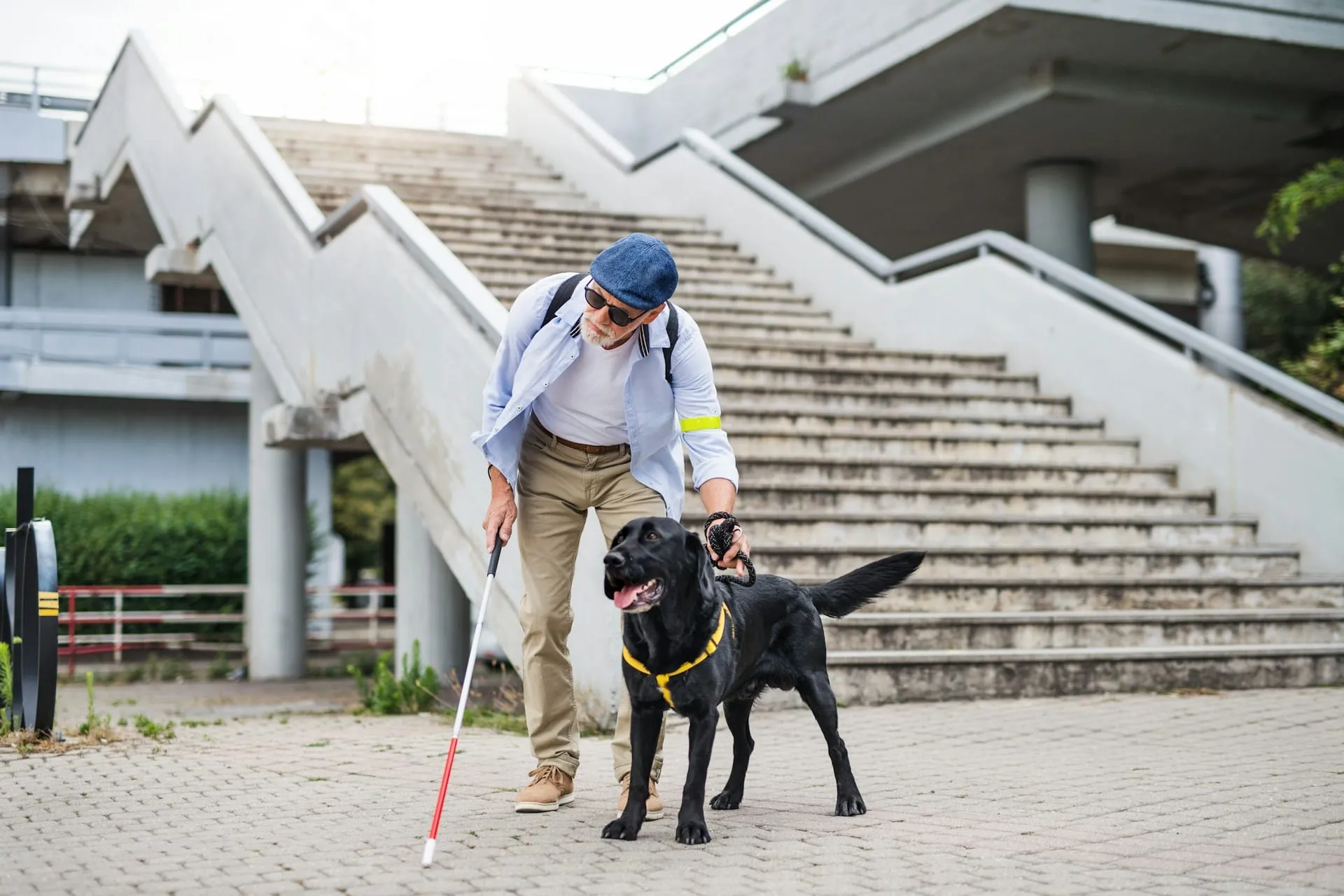
If you’ve lost your service dog, you’re living through something most people around you will never fully understand. They’ll offer condolences on the loss of a pet. What they won’t see is everything else you’ve lost alongside them. Your service dog wasn’t just your companion. They were your mobility, your warning system, your ability to move through the world safely. Losing them is service dog loss grief in its most complete form, and it doesn’t fit neatly into any single category.
This is what we mean when we call it dual trauma. You’re not grieving one thing. You’re grieving two, simultaneously, and in ways that complicate each other. The bond you shared is mourned alongside the immediate, practical reality that the life you built around their presence no longer works the way it did yesterday. Both losses are real. Neither one cancels out the other.
What we see in our community, again and again, is that the people around service dog handlers focus almost entirely on the functional loss. “How are you managing without them?” “What will you do now?” Those questions skip directly to logistics and miss the grief entirely. You deserve space for both. This post is written to give you that. We’ll cover why this grief is genuinely different, what its layers actually feel like, how to navigate practical realities while your heart is still broken, and where to find people who understand the specific weight of what you’re carrying.
Key Takeaways
- Service dog loss grief is a dual trauma: You’re mourning a beloved companion and the loss of functional independence at the same time. Both losses are valid and deserve to be grieved, not one at the expense of the other.
- Each type of service dog creates a specific grief: The grief of losing a psychiatric service dog, a guide dog, a medical alert dog, or a mobility assistance dog each carries its own distinct weight, shaped by what that dog made possible in your daily life.
- Insensitive comments hit differently here: “You can just get another one” is especially painful in this context because of the reality of training timelines, waitlists, and the irreplaceable nature of each bond.
- Needing a new service dog while grieving is one of the most complex emotional experiences in pet loss: Feeling urgency about a replacement while still in acute grief is not a sign that you didn’t love your dog enough. It’s the reality of disability, and it deserves compassionate support.
- Grief support exists for this specific loss: Pet loss grief counselors and communities understand the human-animal bond. Some specifically support handlers navigating the intersection of grief and disability. You don’t have to find a general therapist and explain it from scratch.
Table of Contents
- 1What Makes Service Dog Loss Different from Other Pet Loss
- 2The Companion Grief: Loving a Dog Who Was Also Your Partner
- 3The Functional Grief: When Independence Leaves With Them
- 4How Each Type of Service Dog Shapes the Grief
- 5The Grief No One Around You Sees
- 6What People Say That Makes It Harder
- 7Navigating the Practical Reality While You’re Still Grieving
- 8The Guilt of Needing a New Service Dog
- 9Where to Find Grief Support That Understands This Loss
- 10Honoring a Service Dog Who Served You
- 11Getting Through Service Dog Loss Grief, One Layer at a Time
- 12Frequently Asked Questions About Service Dog Loss
What Makes Service Dog Loss Different from Other Pet Loss
The loss of a service dog is different because your dog wasn’t just a beloved animal. They were a trained working partner whose presence structured your daily life in concrete, functional ways. The grief includes everything that comes with losing a companion you loved deeply, and it also includes an immediate, disorienting loss of capability that begins the moment they’re gone. That’s not a metaphor. That’s the reality of how interdependent your lives had become.
When someone loses a family pet, the loss is profound and real. The empty bed, the missing sounds, the routines that no longer make sense. Those are genuine and painful. But the person grieving can still walk to the grocery store, navigate their commute, manage their medical needs, or move through most days without their pet’s direct assistance. When you lose a service dog, the loss of the relationship and the loss of function arrive together. You may wake up the morning after they die and immediately face something you cannot do safely without them.
That simultaneous arrival is what makes this a dual trauma. The word “trauma” is accurate here. Not used loosely for dramatic effect. The sudden removal of both a central emotional relationship and a significant functional support system in a single moment is genuinely traumatic. Your nervous system and your heart are both trying to respond to a loss that operates on two channels at once.
There’s also a unique visibility to this grief. Service dogs are public. They go everywhere with you. They’re known by your neighbors, your coworkers, your regulars at the coffee shop. When they’re gone, people notice. And their noticing can bring attention at a moment when you’d rather grieve privately. The absence of your dog is visible before you’ve had time to absorb it yourself.
The Companion Grief: Loving a Dog Who Was Also Your Partner
Before we get to anything else, this part deserves its own space. Your service dog was your dog. Not just your tool. Not just your accommodation. Your dog. The years you spent together, the way they learned your rhythms and you learned theirs, the specific shape of their presence in your life, that was a relationship. And it deserves to be grieved as one.
Renata, 38, lost her psychiatric service dog Huxley after a sudden illness. Huxley had been with her for six years, trained to recognize the earliest signs of her dissociative episodes and ground her before they escalated. What Renata describes isn’t the loss of a coping tool. It’s the loss of a being who knew her. “He knew what was happening inside me before I did,” she said. “There’s no replacement for that. Not another dog, not a medication. He was mine, and I was his.”
The companion grief here is the same category of grief that any person feels after losing a deeply bonded animal. The grief and emotions that come with pet loss have been studied extensively. The human-animal bond activates the same neurological and emotional systems as human attachment. The grief that follows is no less grief. It’s grief. What you feel when you lose a service dog you loved is real, proportional, and deserves the same acknowledgment as any other significant loss.
Don’t let anyone, including the part of your own brain that might redirect you toward logistics, rush past this layer. The functional loss is real and will need attention. But the companion grief is the foundation, and it needs to be felt.
The Functional Grief: When Independence Leaves With Them
The functional grief is the part that makes service dog loss uniquely complicated, and it often gets all of the external attention while the companion grief gets none. It’s the immediate, practical reckoning with what your world looks like now that they’re gone.
Dominic, 54, relied on his mobility assistance dog Archie for seven years. Archie braced for him on the stairs, retrieved dropped items, opened doors, and provided the physical support that enabled Dominic to live independently at home. When Archie died of cancer, Dominic was devastated as a dog owner and immediately faced a different kind of crisis. Tasks he hadn’t thought about in years, because Archie simply handled them, were suddenly impossible or dangerous without help. “The grief and the panic came at the same time,” he said. “I didn’t have the luxury of just being sad.”
That’s the functional grief. The realization that your independence, your routines, and your sense of what you’re capable of were all built with your dog as a structural part. And now that structure is gone.
This grief also carries a particular weight because it’s often invisible to the people around you. They can see you crying. They can imagine that you miss your dog. But they can’t easily see the thing you can’t do today that you could do yesterday, or the specific way that gap changes what your next months look like. The physical symptoms of grief after the loss of a pet are real enough on their own. Layered on top of an existing disability, they can be genuinely destabilizing.
Functional grief deserves to be named separately, because naming it helps you be honest about what you actually need. You need to grieve your dog. And you need practical support while you do. Those are two different needs, and you’re allowed to have both.
How Each Type of Service Dog Shapes the Grief
Service dogs are trained for widely different tasks, and the specific nature of that work shapes the grief in distinct ways. Understanding your particular loss matters because one handler’s experience may look very different from another’s, even though both are grieving a service dog.
Psychiatric Service Dogs and the Loss of Invisible Support
Psychiatric service dogs support people with conditions like PTSD, anxiety disorders, bipolar disorder, and major depression. They interrupt panic attacks, create physical boundaries in crowds, perform room checks, provide deep pressure therapy, and, in some cases, recognize the physiological signs of an oncoming episode before the person consciously does. Their work is largely invisible to everyone except the handler.
When a psychiatric service dog dies, the grief is compounded by the fact that the work they did was so personal and so internal. Explaining to people why you’re not okay, and why their absence has left you without support systems that weren’t visible to anyone, is exhausting. The grief is real, and it’s happening simultaneously with a reduction in the very supports that would help you manage it.
Guide Dogs and the Loss of Navigation Partnership
Soleil, 29, had worked with her guide dog Pepper for four years before Pepper was retired from service due to a health condition. Pepper died two months after retirement, before Soleil had finished transitioning to a new dog. “I was already grieving the partnership,” Soleil said. “And then I lost her entirely.” Guide dog handlers often describe their dog not as an aid but as an extension of their own navigation. The specific, calibrated trust between a guide dog team takes years to build and cannot simply be transferred.
The grief after losing a guide dog includes mourning a unique form of autonomy that was built on deep, specific trust. The world is navigable again only after a new partnership is built from scratch, and that can take years.
Medical Alert Dogs and the Fear That Follows Loss
Medical alert dogs trained to detect diabetic episodes, seizures, severe allergic reactions, or other medical events occupy a specific role: they keep their handlers safe from invisible, unpredictable threats. Losing one doesn’t just mean losing companionship and independence. It can mean losing a layer of physical safety.
The grief after losing a medical alert dog often includes a fear component that other handlers may not experience as acutely. Going to sleep, being alone, or going out in public can all carry a new risk that wasn’t there when the dog was alive. That fear is its own kind of loss, and it’s reasonable. It also makes the grief more acute because the stakes of the functional absence feel higher.
The Grief No One Around You Sees
There is a layer of grief from the loss of a service dog that exists almost entirely within the handler. It doesn’t show up easily in conversation. It doesn’t map onto the frameworks most people have for pet loss. And it’s one of the things we hear about most consistently from handlers in our community.
It’s the loss of identity.
For many handlers, the partnership with their service dog is woven into who they are. Not just what they can do, but how they move through the world, how they’re perceived, what they’re capable of. The handler-dog team is a unit. And when that unit dissolves, there’s a disruption to identity that goes deeper than grief for a lost companion and deeper than practical problem-solving about lost function.
Renata put it this way: “For six years, I was the person with Huxley. People knew me that way. The staff at my building. My neighbors. My coworkers. And now I’m just…different. Not just sad. Different.”
This identity disruption is real, and it doesn’t get enough acknowledgment. The social visibility of service dog partnerships means that the absence is noticed publicly before you’ve processed it privately. People who saw you and your dog every day will ask questions you’re not ready to answer. Well-meaning strangers may comment on your dog’s absence at the worst possible moment. You’re navigating public grief for a loss you haven’t had time to absorb yet.
There’s also the grief of the system itself. If your service dog came from a program, that program had structure, training, and a sense of community. The end of the partnership can also feel like a separation from that world. And if you’ll need to re-enter a waitlist, that grief carries its own specific weight.
What People Say That Makes It Harder
People say things. Most of them mean well. Almost none of them help. And a few specific comments land especially badly in the context of service dog loss.
“You can just get another one” is the one we hear about most. And in this particular context, it’s not just dismissive of the bond. It’s factually wrong in a way that makes it worse. Getting another trained service dog is not a matter of visiting a shelter or calling a breeder. Service dogs are trained through programs with waitlists that frequently run for 2 to 4 years. The training period alone can last one to two years. “Just getting another one” describes a process that may take three to five years and is not guaranteed. Saying it suggests a fundamental misunderstanding of what has been lost and what the path forward actually looks like.
“At least they had a good life serving you” is another one. It reframes your dog’s life as being for your benefit and reduces the relationship to a function. Your dog wasn’t serving you out of duty. They were your partner, and they had a life that included love, play, rest, and relationships. Their death is not softened by the fact that they were useful. It’s made more complex by it.
For specific guidance on handling these moments with language that actually helps, our resource on responding to insensitive comments about pet loss offers practical scripts and frameworks you can use. You shouldn’t have to manage other people’s responses while you’re this deep in your own grief, but sometimes you have no choice, and having language ready helps.
What you actually need to hear, and what we want to say directly: this loss is exactly as significant as it feels. You’re not being dramatic. You’re not overreacting. You lost your dog. And you lost the life that was built around them. Both of those things are true.
Navigating the Practical Reality While You’re Still Grieving
You may not have the luxury of grieving before you have to act. That’s one of the hardest parts of service dog loss, and it’s worth being honest about rather than pretending there’s a way to neatly separate grief from practicality.
The first thing to say is this: you’re allowed to do both at the same time. You’re allowed to be devastated and to make necessary phone calls. You’re allowed to cry all morning and then spend the afternoon figuring out interim support options. Grief and function don’t have to wait for each other. They often can’t.
Some practical things to consider in the early days:
- Contact your program or certifying organization as early as you’re able. Many programs have protocols for handling grief and can provide guidance on the process and timeline for a new placement. You don’t have to make any decisions. Reaching out early just opens the door.
- Think about interim support. Depending on your disability, this might mean temporarily adjusting your routines, asking trusted people for specific help, or exploring other assistive technology or accommodations for the period before you have a new partner.
- If your dog came from an owner-training background, connecting with your training community early can provide both emotional support and practical guidance about next steps.
- Consider whether your medical team needs to know. If your service dog supported a medical condition, your doctor or psychiatrist may be an important person to loop in, both for your safety and to potentially document the loss for any accommodations or support you might need in the interim.
Practical action doesn’t mean you’re not grieving. It means you’re doing what you have to do while you grieve. Those are not in conflict, even when they feel like they should be.
When you’re ready to think about self-care during this period, and “ready” can mean different things for different people, our post on self-care while grieving a pet has grounded, specific suggestions that aren’t about wellness performance. They’re about keeping yourself functional enough to get through the days ahead.
The Guilt of Needing a New Service Dog
This piece of service dog loss grief is specific, painful, and deeply underacknowledged. And we want to name it clearly: needing a new service dog while you’re still actively grieving the one you lost is not a betrayal. It’s not evidence that you didn’t love them enough. It’s the reality of disability, and it deserves compassion rather than judgment, including from yourself.
The guilt shows up in a few different ways. Sometimes it’s the feeling that beginning the process of finding a new dog is somehow rushing the grief or disrespecting the one you lost. Sometimes it’s a more diffuse discomfort about “replacing” them, a word that almost every handler we’ve heard from rejects instinctively. Sometimes it’s the shame of feeling practical necessity pulling at you before the grief has settled, as if needing what you need makes you somehow less devoted.
Mireille, 46, who had relied on a seizure alert dog named Cosmo for nine years, described the guilt this way: “He died on a Tuesday. By Thursday, I was thinking about what comes next. And I hated myself for it. I felt like I was already moving on. But I wasn’t. I was just terrified.”
Mireille’s experience is not unusual. It’s also not a sign that she loved Cosmo less. It’s a sign that she was managing grief and fear simultaneously, doing the honest human thing of surviving while mourning.
If you’re struggling with guilt about the decisions ahead of you, our post on coping with guilt and regret after pet loss may help you give yourself more room than you’re currently allowing. And when the time eventually comes to think about a new dog, the question of when to get a new pet after loss is one that only you can answer, on your own timeline, with your own disability and your own grief as the guide.
No one else’s timeline is the right one. Not your program’s, not your family’s, not some assumed schedule based on how long grief is “supposed” to take. Yours is the one that matters.
Where to Find Grief Support That Understands This Loss
Finding support that actually fits this grief is harder than it should be. General pet-loss support is more readily available than it used to be, which is good. But service dog loss sits at the intersection of pet loss and disability, and not every support resource is equipped for that specific combination.
The grief counselors and therapists who specialize in pet loss are often better equipped for this than general therapists, because they already understand the depth and legitimacy of the human-animal bond without needing it explained to them. Our directory of pet loss grief counselors is a place to start. When you reach out, it’s reasonable to mention that your loss involves a service dog relationship and ask whether the counselor has experience with that specific context.
Peer support can be especially valuable here. Connecting with other handlers who have been through this loss creates an understanding that doesn’t require you to explain the basics. Support groups and communities focused on pet loss can provide that, and some specifically support people navigating the loss of a service animal. Your program or certifying organization may also know of handler-specific grief resources.
If your disability involves a medical component, a veterinary social worker may also be a valuable resource to explore. Veterinary social workers work at the intersection of animal relationships and human wellbeing, and some have specific experience with service animal handlers and the complexity of this kind of loss.
You deserve support that meets you where you actually are. Not support that understands the pet loss part but not the disability part, or the disability part but not the grief. Both things are true about your experience, and both deserve to be held.
If the grief has moved into depression or anxiety, which is a real and common outcome, speaking with a grief counselor or therapist who specializes in pet loss can provide support that’s specific to what you’re carrying.
Honoring a Service Dog Who Served You
Your service dog gave you something most people will never fully understand. The work they did, day after day, was not only training. It was devotion, presence, and partnership. Honoring that is worth your time, even in the middle of grief, and sometimes especially in the middle of it.
Some handlers find that creating a specific memorial helps give the grief somewhere to go. This might be a physical memorial, a framed photo, a piece made from their fur, or a paw print casting, something that holds their presence in a form you can return to. Our memorial collection includes options designed for the specific experience of honoring a dog you loved deeply.
Others find that telling the story matters. Writing about your dog, the specific things they did, what their presence felt like, the moments that defined your partnership, is a way of preserving what was real about them. Not just “they were a good service dog.” The specific things. The way Huxley would put his head in Renata’s lap exactly when she needed it. The way Archie would stand at the bottom of the stairs and look back to check on Dominic before moving. Those details are worth keeping.
Honoring your service dog doesn’t require a grand gesture. It can be as simple as speaking their name when you tell someone what you’ve been through, rather than just saying “I lost my service dog.” They had a name. They had a personality. They had a life. All of that deserves to be remembered with specificity.
And when you’re ready, and only when you’re ready, acknowledging the depth of what they gave you is also part of the honor. The years of capability, safety, and presence made possible by them. That’s not a reason to feel better now. It’s something to hold as part of who they were.
Getting Through Service Dog Loss Grief, One Layer at a Time
Service dog loss grief doesn’t resolve in a single direction. You’re not just moving through sadness toward acceptance. You’re moving through multiple overlapping losses that don’t all follow the same trajectory. The companion grief may soften on a different timeline than the functional grief. The identity disruption may be the last thing to settle. And the guilt may spike at unexpected moments, like the first time you consider contacting a program, or the first time you feel ready to be with another dog.
All of that is normal. Not in the sense that it’s easy, but in the sense that it’s an accurate and proportional response to something genuinely complicated. You’re not grieving “too much” or “in the wrong order” or “for too long.” You’re grieving a dual loss, and dual losses take time. The resources at Love, Baxter are built for people in the middle of it, not for people who have already figured it out.
What we’d ask you to hold onto, if you can hold onto anything right now: the layers don’t all have to be resolved before you’re allowed to begin moving. You can still be grieving the companion loss while you start the process of addressing the functional gap. You can still miss your dog every single day while building toward what comes next. Grief and forward motion are not opposites. They happen at the same time, messily, and that’s not a sign that anything has gone wrong.
You loved your dog. You relied on them. You built a life together. That’s worth grieving fully, across all the layers, for as long as it takes. And you don’t have to do it alone.
The last chapter with a dog has its own rhythm. Our dog end-of-life collection walks through it.
Frequently Asked Questions About Service Dog Loss
Is it normal to feel like I lost my independence and my companion at the same time?
Yes, and naming both losses separately is important. Service dog loss involves what grief practitioners describe as dual trauma: the simultaneous loss of a deeply bonded companion and the functional partner who made your daily independence possible. Both losses are real, and both are happening at the same time. Feeling the weight of both at once is not an exaggeration or a sign of instability. It’s an accurate response to what you’ve actually lost. Many handlers describe a period of emotional grief and practical crisis running in parallel, and that experience, as destabilizing as it is, is a normal part of this specific kind of loss. You’re not supposed to neatly separate the two, because they’re connected in the same way your life with your dog was connected. Give yourself room to grieve both without prioritizing one over the other.
How do I deal with people who say, “You can just get another service dog”?
This comment is among the most common and most painful responses that service dog handlers hear after a loss, and it’s worth understanding why it lands so badly. It’s not just emotionally dismissive of your bond with your dog. It’s also factually incorrect, which makes it feel even more isolating. Service dogs come from programs with waitlists that can run for 2 to 4 years. The training and matching process takes additional time after that. The idea that another trained service dog is readily available is a misunderstanding of how the entire system works. When you hear this comment, you’re under no obligation to educate anyone while you’re grieving. You can simply say “it’s more complicated than that” and leave it there. If someone in your life keeps pressuring you, our resource on handling insensitive comments about pet loss includes specific language for situations like these. You’re allowed to protect your grief from people who don’t understand it.
I feel guilty for already thinking about getting a new service dog. Is something wrong with me?
Nothing is wrong with you. What you’re experiencing is a specific and deeply underacknowledged piece of service dog loss: the collision between acute grief and the practical reality that your disability doesn’t pause while you mourn. Needing to think about what comes next is not a sign that you loved your dog less. It’s a sign that you’re living with a disability that was structured around your dog’s presence, and that reality doesn’t disappear when they do. Thinking about next steps while you’re still in grief is not moving on. It’s managing two things simultaneously, which is what this kind of loss often requires. The guilt you feel is real, but it isn’t telling you the truth. You can love your dog completely, grieve them deeply, and still need to think about how you’re going to manage your disability going forward. Those things are not in conflict, even when they feel that way.
Where can I find support that specifically understands the loss of a service dog?
Grief support that genuinely fits this loss is at the intersection of pet loss and disability, and not every resource addresses both. Pet loss grief counselors are often a good starting point, because they already understand the depth of the human-animal bond without needing extensive explanation. When you reach out, it’s worth specifically mentioning that your loss involves a service dog relationship and asking whether the counselor has experience with that context. Peer support from other handlers who have been through this loss can also provide an understanding that general support groups may not offer. Your service dog program or certifying organization may be aware of handler-specific grief resources. Veterinary social workers are another option worth exploring, particularly if your disability has a medical component. The goal is to find support that holds both parts of your experience without requiring you to minimize either the grief or the disability.
How long does service dog loss grief last?
There’s no set timeline, and anyone who offers one is simplifying something that doesn’t simplify cleanly. Service dog loss involves multiple overlapping losses, and they don’t all resolve on the same schedule. The acute companion grief, the intense early pain of missing your specific dog, tends to shift over time, but the timeline varies widely from person to person. The functional grief may ease when you have more support or a new partner. The identity disruption and the sense of being a changed person can take longer than either of the others. Research on grief consistently shows that the goal isn’t to stop grieving on a particular date. It’s to move through grief in a way that allows you to eventually build a life that holds the loss without being defined only by it. If your grief is significantly impairing your ability to function or is accompanied by severe depression or anxiety, that’s worth talking to a professional about, not because grief has a deadline, but because you deserve support when it’s that heavy.
On this topic