






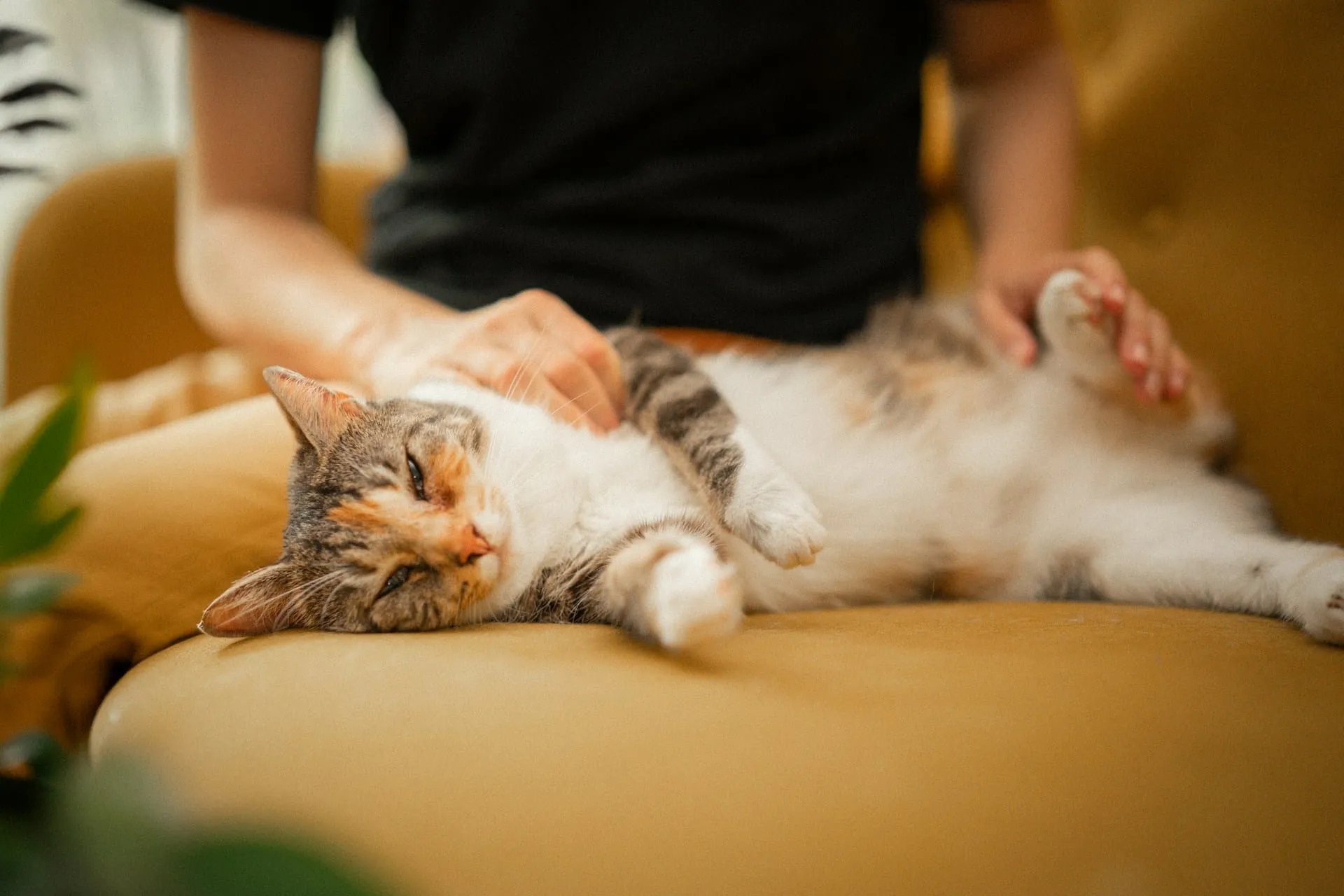
There’s a moment most people recognize: you’re sitting with your senior dog or cat, they’ve finally settled in close, and you’re just resting your hand on them. Not doing anything in particular. Just being there. What you’re doing in that moment is already a form of massage. Your touch communicates something your pet understands, something that reaches beyond all the ways their body is slowing down and tells them they’re not going through it alone.
Senior pet massage is one of the most accessible and meaningful things you can do for an aging animal. It doesn’t require professional training to start. It doesn’t take expensive equipment. What it takes is knowing a few basic principles, understanding what your aging pet actually needs, and learning to read their cues. Done well, massage can ease the physical discomfort that comes with getting older, calm an anxious nervous system, and give you a way to actively care for your pet during a time when so much feels out of your hands.
We hear from pet parents constantly who feel helpless watching their senior pet slow down. They want to do something meaningful, something that matters right now. This is one of those things. The research on canine massage supports what pet parents have always known intuitively: touch is medicine. Not a replacement for veterinary care, but a real, documented complement to it. And for cats, who are notoriously harder to read, there are ways to offer the same comfort on their terms.
Key Takeaways
- Senior pet massage has been shown to have physical benefits for aging dogs and cats, including improved circulation, reduced muscle tension, and lower anxiety. The touch itself is therapeutic, not just comforting.
- Over 50% of dogs over age 7 develop some form of arthritis, a widely accepted fact in veterinary medicine. A gentle massage can help manage associated discomfort as part of a broader care plan.
- Cats and dogs have very different tolerances for massage. Cats generally prefer shorter sessions, lighter pressure, and more frequent check-ins.
- Reading their signals matters more than following a set routine.
- There are specific areas to always avoid, including the spine, any lumps or growths, and visibly inflamed joints. Your pet’s response will tell you quickly if you’ve found a sensitive spot.
- As a pet approaches the end of life, massage becomes one of the most powerful forms of comfort you can offer. It doesn’t require your pet to do anything. It just requires you to be present with them.
Table of Contents
- 1Why Touch Matters More as Your Pet Ages
- 2Before You Begin: What to Know About Senior Pet Bodies
- 3How to Set the Right Environment for a Pet Massage
- 4Basic Massage Techniques for Senior Dogs
- 5Massaging Senior Cats: What’s Different
- 6Areas to Always Avoid
- 7How Long and How Often
- 8When Massage Becomes Part of End-of-Life Comfort Care
- 9Making the Most of the Time You Have Together
- 10Frequently Asked Questions About Senior Pet Massage
Why Touch Matters More as Your Pet Ages
Senior pet massage works on two levels at once: physical and emotional. On the physical side, massage stimulates circulation, which is particularly valuable for aging animals whose cardiovascular efficiency has decreased. Better circulation means more oxygen reaching muscle tissue, more efficient flushing of metabolic waste, and, for dogs with arthritis, some relief from the stiffness that accumulates in underused muscle groups around affected joints.
The American Kennel Club has recognized dog massage as beneficial for improving circulation, reducing anxiety, and supporting pain management in senior dogs. A 2021 cross-sectional study published in Veterinary Record (Riley et al.) found that canine massage therapy may effectively reduce the severity of myofascial and musculoskeletal pain in dogs and improve quality of life. The research aligns with what many pet parents and integrative veterinary practitioners have observed anecdotally for years: this is not a placebo.
The emotional case is harder to quantify, but just as real. Senior pets often experience heightened anxiety as their senses fade and their physical confidence decreases. A dog who once moved through the world without hesitation begins to navigate more carefully, more nervously. A cat who was independent and self-sufficient becomes more tentative. Consistent, gentle physical contact from someone they trust activates the parasympathetic nervous system, slowing heart rate, reducing cortisol, and signaling safety. That is a direct, measurable benefit to quality of life.
There’s also something that belongs in any honest conversation about this: the benefit runs both directions. Pet parents who are navigating anticipatory grief as their pet declines often describe feeling helpless. Massage gives you something to do with that love. It gives your hands a job. And the research on human-animal touch suggests that the act of caring physical contact is regulating for the caregiver too, not just the animal.
Before You Begin: What to Know About Senior Pet Bodies
Aging bodies carry more complexity than younger ones. Before you start any massage routine with a senior pet, spend a few minutes just observing. Watch how they move. Notice how stiff they are when they get up. Pay attention to where they flinch or avoid being touched. All of that is information.
Arthritis is common in older pets. According to widely cited veterinary statistics, over 50% of dogs over age 7 develop some form of arthritis. Cats have a similar prevalence, though their discomfort often goes undetected for longer because they hide it so effectively. Arthritis creates inflammation in and around joints. During a flare, that tissue is sensitive, and massaging an inflamed joint directly can cause pain rather than relieve it. The goal with arthritic pets is to work the muscle tissue surrounding the joints, not the joints themselves, and to support circulation without adding pressure where the body is already stressed.
Older pets also tend to develop lumps, bumps, and growths under the skin. Many are benign, but your vet should evaluate any lump you haven’t had checked. During a massage, avoid pressing directly on any growth. Even a benign lipoma can be tender, and a growth that’s actively concerning should not be manipulated at all until your vet gives guidance.
If your pet has a recent surgery, an open wound, a skin condition, or a known cancer diagnosis, check with your veterinarian before beginning massage. This is a reasonable first conversation to have with your vet to better understand your senior pet’s overall care needs. Most vets will be supportive of gentle home massage and can tell you if there’s any specific reason to hold off.
Spend a few sessions just doing gentle stroking before you introduce any technique. Let your pet show you what they welcome and where they’re guarded. The best senior pet massage is always a conversation, not a procedure.
How to Set the Right Environment for a Pet Massage
The environment matters more than most people expect. A senior pet who’s anxious or overstimulated won’t settle into a massage the way a calm one will, and the physiological benefits are reduced when the nervous system stays on alert.
Start with a quiet space. Loud noise, a TV at high volume, or children running through the room will keep your pet’s attention fragmented. This doesn’t have to be a dedicated room or a special setup. It just needs to be somewhere your pet already feels safe. Their bed, your bed, a favorite spot on the couch. Familiar surfaces help.
Low, warm lighting helps with settling. Bright overhead lights signal alertness to most animals. If you can dim things down or move to a room with softer light, that’s worth doing.
Timing matters too. Don’t attempt massage right after a meal, or right after exercise, or when your pet is clearly in a high-alert state. The best window is when they’ve already chosen to rest somewhere comfortable. You’re joining them in that state, not pulling them into one they haven’t chosen.
Your own state matters. If you’re stressed, rushing, or distracted, your pet will feel it. Senior dogs in particular are extraordinarily attuned to their people’s emotional state. Take a breath before you start. Slow your movements down. Let your hands be soft before they make contact.
Basic Massage Techniques for Senior Dogs
Senior dog massage doesn’t require memorizing a formal protocol. What it requires is understanding a few core techniques and knowing where to apply them gently. Always start with observation, then with light contact, and build only if your dog is clearly relaxed and leaning into the touch.
Effleurage is the right starting point for any session. It’s a French term, but the technique is simple: long, slow, gliding strokes along the body using a flat hand with light pressure. Think of it as warming up the tissue before anything deeper. Move your hand from the neck toward the tail in one fluid motion, following the direction of the fur. This signals to the nervous system that contact is coming, gets circulation moving in the surface tissue, and gives your dog a chance to relax into the touch before any deeper work begins.
From there, gentle kneading of the large muscle groups can help relieve muscle tension. The shoulders, hindquarters, and the long muscles on either side of the spine (but not the spine itself) respond well to slow, circular pressure using your fingertips or the heel of your hand. Don’t rush. Use less pressure than you think you need. Senior tissue is more sensitive than younger tissue, and a dog who’s uncomfortable will shift away, stand up, or turn to look at you. Those are signals to ease off.
Focus areas for senior dogs:
- Shoulders and upper chest, where dogs carry tension to compensate for hip or rear-leg weakness.
- Hindquarters and rear leg muscles, which often become tight around arthritic hips. Work the muscle belly, not the joint itself.
- Neck and jaw, particularly in dogs who have dental discomfort or who hold tension from anxiety.
- The base of the skull is where gentle circular pressure with fingertips often produces visible relaxation responses.
- Paws and lower legs, using gentle circular strokes from paw to elbow or knee. This supports circulation in limbs that may be less active.
Watch for positive responses: a deep exhale, eyes softening or closing, weight shifting toward your hands, a general settling of the body. These tell you the touch is landing well. You’re looking for connection, not performance. A ten-minute session with a fully relaxed dog is worth far more than thirty minutes of a dog who’s tolerating the contact but not benefiting from it.
If you want to learn more structured techniques, the professionals in our holistic and integrative therapies directory include certified animal massage therapists who can teach you directly, either in person or via guidance sessions.
Massaging Senior Cats: What’s Different
Cats are not small dogs. Their relationship to touch is fundamentally different, and the rules that apply to dogs don’t translate cleanly to cats. If you approach a senior cat with the same session structure you’d use for a senior dog, you’re likely to get a look of mild offense and a very deliberate departure.
The main difference is consent. Cats are extremely clear about when they want contact and when they don’t, but they communicate it in ways that are easy to miss until you’ve learned to read them. A slow tail flick, a skin ripple along the back, ears that rotate slightly backward, a shift in body tension: these are all early signals that the cat is reaching their limit. Miss those, and you’ll get a swipe or a bite, which is the cat’s version of “I told you several times.”
For senior cats, shorter sessions work better. Three to five minutes of focused, gentle contact is often all they want. The areas most cats accept well are around the head and neck: the base of the ears, the cheeks just behind the whiskers, and the back of the neck just below the skull. Long-stroke effleurage along the back from head to tail base is often welcome, but watch for the skin ripple that signals overstimulation.
Pressure on cats should be notably lower than on dogs. Think of it less as a massage and more as deliberate, slow, attentive petting. The physiological benefits, improved circulation, nervous system regulation, and muscle tension relief, are still available with that lighter touch. You’re just working with the cat’s parameters rather than your own.
Senior cats with arthritis often have significant discomfort in their hips and lower back. They may be more reluctant to be touched there. Don’t push into it. Instead, work the surrounding muscle groups very gently and let the cat tell you what they can accept. A cat who’s in real pain will usually remove herself from the situation entirely. One who’s just stiff may, with time, lean into light contact with the adjacent muscles.
Our senior pet care resources cover cat-specific comfort care in more depth, including how to recognize when a cat’s pain is being under-managed.
Areas to Always Avoid
Knowing where not to touch is as important as knowing where to focus. For senior pets in particular, some areas should be left alone during massage, and your pet’s response should always take precedence over any technique you’ve read about.
Avoid these areas:
- The spine directly. The vertebral column is not a massage target. Work the long muscles on either side of it, not the spine itself. This applies to dogs and cats equally.
- Joints that are actively inflamed. An arthritic joint that is warm to the touch, visibly swollen, or causing obvious pain is not appropriate for massage. Work the surrounding muscle instead.
- Any lump, bump, or growth that hasn’t been evaluated by a vet, or any that your vet has flagged as concerning. Don’t press on, knead around, or manipulate growth tissue.
- Any area your pet moves away from, guards with body language, or responds to with muscle tension, a sharp turn of the head, vocalization, or a snap. That’s a clear no. Honor it without question.
- Open wounds, rashes, hot spots, or any area with broken or inflamed skin. Massage introduces friction and pressure, which can worsen these conditions.
- The abdomen in pets with known organ conditions, a history of bloating, or any undiagnosed abdominal discomfort. If you’re unsure, ask your vet first.
Senior pets have more areas that require this kind of awareness than younger ones. That’s not a reason to avoid a massage. It’s a reason to approach it thoughtfully and stay attentive throughout. The best massages happen in a back-and-forth with your pet, not to your pet.
How Long and How Often
There’s no single answer to how long a senior pet massage session should be. A dog in the early stages of aging who’s relaxed and receptive may enjoy twenty to thirty minutes. A dog who’s in significant decline, who tires quickly, or whose energy is limited, may want five minutes before they shift or close their eyes and drift. Follow their lead, not a timer.
For most senior dogs who tolerate massage well, 10 to 15 minutes a few times per week is a reasonable starting point. Daily massage is absolutely fine if your dog welcomes it and you have the time. There’s no documented risk of “too much” gentle massage in a healthy senior dog. The risk lies in applying too much pressure or failing to read discomfort cues, not in frequency.
Senior cats typically prefer shorter sessions more frequently than longer ones. Three to five minutes daily tends to work better than a twenty-minute session twice a week. You’re working with their tolerance window rather than against it.
Watch for these cues that it’s time to stop:
- Your pet shifts their weight away from your hands or moves out of reach.
- Muscle tension increases instead of decreasing.
- They stop making eye contact or look away persistently.
- Vocalization: whimpering, a low growl in dogs, or a chirp or hiss in cats.
- They simply get up and walk away. That’s a complete and sufficient answer.
Always end a session before your pet reaches their limit, not after. A massage that ends while the animal is still relaxed and comfortable builds a positive association. One that ends because the pet pulled away does the opposite. You want them to look forward to the next session, not tolerate this one.
When Massage Becomes Part of End-of-Life Comfort Care
The conversation about senior pet massage shifts as a pet enters the final stage of life. At that point, the goal isn’t rehabilitation or muscle conditioning. Its presence. It’s keeping your pet comfortable, letting them feel your touch, and offering something meaningful in the time that remains.
For pets in hospice or palliative care, massage takes on a different quality. Sessions get shorter. Pressure gets lighter. The focus moves entirely to what feels good to the animal right now, today, in this body that may be doing less and less each week. Touch becomes about connection more than technique.
What we consistently hear from pet parents who have been through this is that the hands-on time in those final weeks and days matters more than almost anything else. Not because it extends life. It doesn’t. But because it makes clear, in a language that requires no words, that your pet is not alone, that they are loved, that you are there.
If your pet is approaching the end of life and you’re not sure about their pain level or how to adjust your approach, a quality-of-life consultation with a specialist can give you a clearer picture. These consultations are designed to help you understand what your pet is experiencing and how to support them as much as possible in the time they have. Preparing for pet loss involves more than logistics. Knowing how to physically care for your pet through the final stage is part of it.
Professional animal massage therapists who specialize in end-of-life care also exist. Finding someone through our senior pet care provider directory who works with hospice situations can supplement what you’re doing at home and teach you additional techniques tailored to your pet’s specific condition.
Making the Most of the Time You Have Together
Senior pet massage isn’t just something you do for your pet. It changes how you’re present with them. It slows you down. It asks you to pay close attention to a body that’s changing, to notice small things, to respond to what’s actually happening rather than what you expect. That quality of attention is its own form of love.
Pet parents often tell us that caring for a senior pet, while genuinely hard, produced some of their most meaningful moments with that animal. The daily rituals of care, the check-ins, the quiet time together on the floor or the couch, the act of putting your hands on your pet and asking “how are you today?” Those moments are not small. They’re the thing.
If you’re finding the weight of anticipatory grief heavy right now, you’re not alone. Many people who are caring for aging pets are already grieving, already feeling the loss beginning even while their pet is still here. That’s real, and it’s documented, and there are resources specifically for it. Our anticipatory grief resources address what this experience actually feels like and how to move through it. The preparing for pet loss category has resources for the practical and emotional dimensions of what comes next.
But right now, in this moment, you have your pet. And your hands. And the simple, profound act of touch. That’s nothing. That’s actually quite a lot.
Senior pet massage is one of the clearest ways to put love into action during a time when so much else is uncertain. Start slow. Pay attention. Let your pet guide you. The techniques matter less than the intention behind them, and that intention, your willingness to show up and be present in your pet’s body and in their experience, is something they already understand.
Frequently Asked Questions About Senior Pet Massage
Can I hurt my senior dog by massaging them incorrectly?
Yes, it’s possible to cause discomfort if you use too much pressure, work directly on inflamed joints, or press on areas that are sensitive or injured. But the risks of gentle, attentive home massage are low when you follow a few core principles: start with light touch, watch your pet’s responses closely, and stop immediately if they pull away, tense up, or vocalize. The most common mistakes are using too much pressure (always err on the side of lighter than you think is necessary) and not reading early discomfort cues before they escalate. Senior dogs are generally very clear about when something doesn’t feel right. A yawn, a shift of weight, a muscle twitch, a turn of the head to look at your hands: these are early signals worth respecting. Working the muscle groups around joints rather than directly on the joints is the most important structural rule for arthritic dogs. If your dog has a complex health picture, a quick conversation with your vet before starting can give you specific guidance about what to avoid for their condition.
My senior cat tolerates being petted but won’t sit still for a real massage. What can I do?
What you’re describing is actually the normal baseline for most cats, and the good news is that “real massage” for a cat doesn’t look dramatically different from attentive, intentional petting. The physiological benefits of gentle touch, improved circulation, nervous system regulation, and muscle tension release don’t require your cat to lie still in a formal session. They require consistency, attention, and working within your cat’s tolerance. Start with the areas most cats accept readily: the base of the ears, the cheeks just behind the whiskers, and the back of the neck. Offer short contact (two to three minutes) and let the cat move if she wants to. Over time, many cats habituate to longer, slightly more deliberate touch when the approach is always on their terms. The goal isn’t a formal massage session. It’s regular, intentional physical contact that builds trust and offers comfort. For a senior cat who moves less and may be experiencing more physical discomfort than she shows, even five minutes of calm, focused attention each day makes a real difference.
How do I know if my senior pet is actually feeling better from a massage or just tolerating it?
The difference between a pet who’s benefiting and one who’s tolerating is visible if you know what to look for. A dog who’s genuinely relaxing into massage will show it: a deep, audible exhale, weight shifting toward your hands rather than away from them, eyes becoming soft or closing, muscles visibly softening under your hands, sometimes a gentle groan or sigh. After sessions, a dog who’s benefiting often moves more fluidly for a period, or seeks out rest more easily. A cat who welcomes the contact will stay close, may begin kneading slowly, or will lean into the contact with their head. A pet who’s tolerating but not benefiting will hold more body tension, keep their eyes open and alert, shift position repeatedly, or simply leave when they’re done without any of the settling body language that signals deep relaxation. Not every session produces the same visible results. A dog who’s having a high-pain day may not relax as deeply. That doesn’t mean the session wasn’t helpful. Tracking patterns over time gives you a clearer picture than any single session does.
Is there a difference between dog massage for arthritis and general senior dog massage?
The fundamentals are the same, but the specific focus and precautions shift when arthritis is confirmed. For a dog with arthritis, the priority is working the muscle tissue surrounding affected joints rather than the joints themselves, since the joint tissue is already inflamed, and adding direct pressure can cause pain. You’ll also want to be attentive to warmth in joint areas: a joint that’s warm to the touch is actively inflamed, and that’s a day to do very light effleurage on adjacent muscles rather than any deeper work. For a general senior dog without a diagnosed joint condition, you have more flexibility to work a wider range of muscle groups with somewhat more varied pressure. That said, the principles of attentiveness, light starting pressure, and reading your dog’s responses apply equally in both contexts. If your dog has been diagnosed with arthritis, a conversation with your vet about massage is worth having. Many vets are supportive and can give you specific guidance on which areas to focus on or avoid, depending on where the arthritis is most pronounced in that individual dog.
Should I use any oils or products during a senior pet massage?
For most home massage situations, no oils or products are needed or recommended. Massage works through pressure and movement rather than through any topical substance, and adding oil introduces the risk of your pet licking it off (which may cause gastrointestinal upset depending on the product), staining furniture or bedding, or creating skin irritation if the wrong product is used. Some professional animal massage therapists do use specific, pet-safe formulations in their practice, but this is different from general-use essential oils or human massage products, many of which are genuinely toxic to dogs and cats. Tea tree oil, eucalyptus, peppermint, and many commonly available essential oils are unsafe for pets. If you feel that your senior pet would benefit from topical support, such as a warming or cooling effect on an arthritic area, talk to your vet about what products are appropriate for their specific condition. For a general home massage, clean hands on clean fur is everything you need.
On this topic