







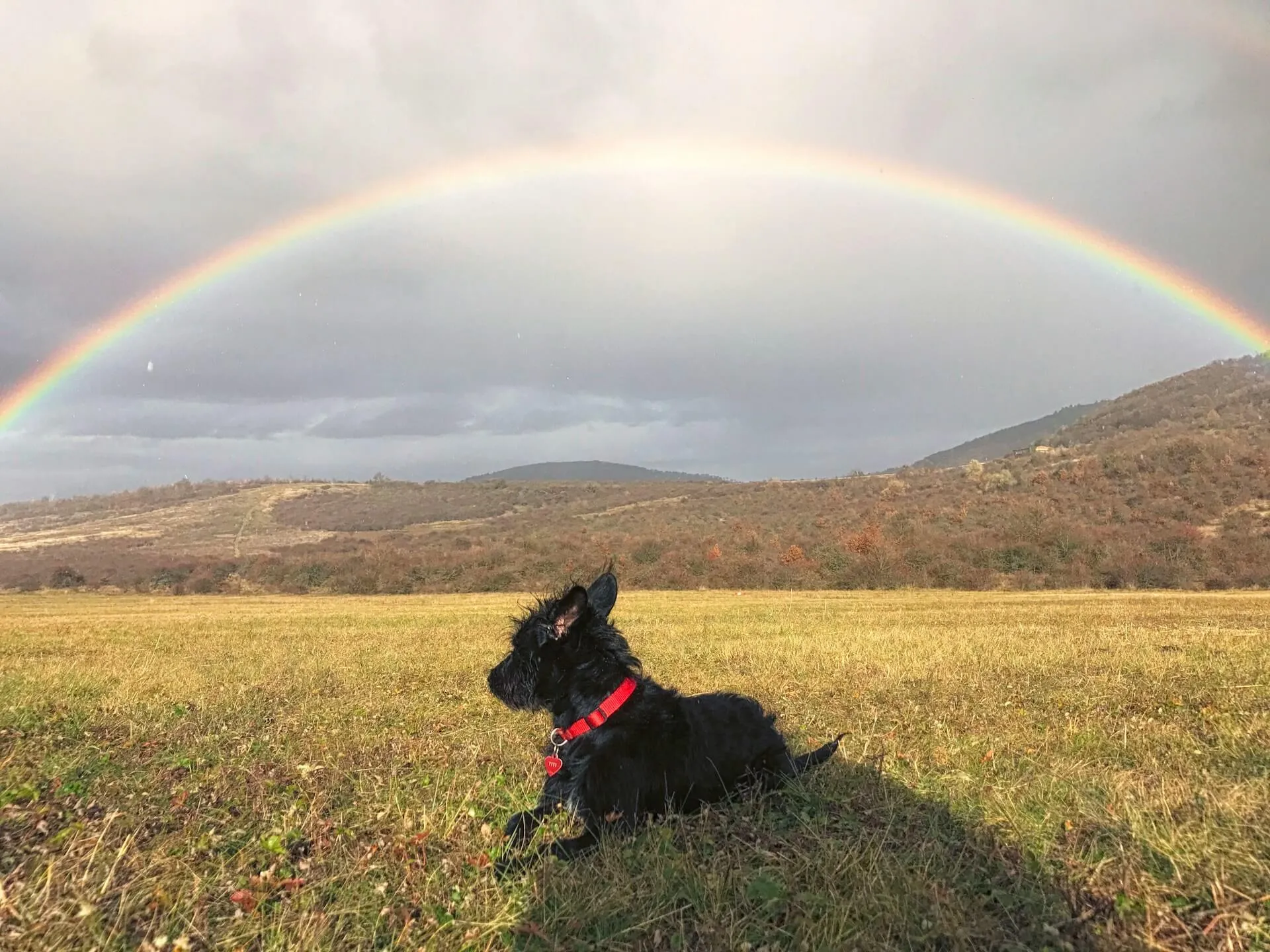
When a pet dies, one of the first things that surfaces for many people isn’t just sadness. It’s a question. Where did they go? Is there something after this? Will I see them again? These questions don’t feel small, because they aren’t. They go right to the center of what it means to have loved a living being who is now gone.
There’s no single answer that all traditions agree on. The Rainbow Bridge offers one picture. Christianity, Judaism, Islam, Hinduism, and Buddhism each bring their own. Secular and naturalistic perspectives offer something different. And for people who hold uncertainty without needing it resolved, that’s its own valid place to stand.
At Love, Baxter, we hear regularly from people who are unsure whether the belief that comforts them is “allowed” by their faith tradition, or whether it’s okay to believe something different from what their religion formally teaches. We hear from secular people who worry that finding meaning in the idea of their pet’s continued presence makes them naive. We hear from people of deep faith who simply don’t know what their tradition says about animals.
This post is here for everyone. We’re not here to tell you what to believe. We’re here to share what different belief systems say, how each one can genuinely support grief, and why the belief that helps you heal is the one that matters. There’s no wrong answer to where your pet went. There’s only what’s true for you.
Key Takeaways
- Rainbow Bridge origins: The Rainbow Bridge poem emerged organically from pet loss communities in the early 1990s, not from any religious scripture or institution, which is part of why it resonates so broadly across belief systems.
- No religious consensus: Major world religions vary widely on what happens to animals after death, and within each tradition, there’s often more nuance and disagreement than a single answer captures.
- Belief serves grief: Research in grief psychology consistently shows that meaning-making beliefs, whether religious, spiritual, or secular, play a genuine role in how people process and integrate loss.
- Personal belief is valid: Many people hold views about their pet’s afterlife that don’t perfectly match their formal religious tradition, and that’s far more common than most people realize.
- Uncertainty is its own answer: Holding open questions without forcing resolution is a legitimate and sometimes deeply honest response to not knowing what lies beyond death.
Table of Contents
- 1Where the Rainbow Bridge Came From
- 2What the Rainbow Bridge Offers Emotionally
- 3Christianity and Animal Afterlife
- 4Judaism, Islam, Hinduism, and Buddhism on Animal Souls
- 5Secular and Naturalistic Perspectives on Pet Loss
- 6The Agnostic Position: Holding Uncertainty with Care
- 7How Belief Actually Helps With Grief
- 8When Families Hold Different Beliefs
- 9Signs and Connections After Losing a Pet
- 10Finding Your Own Answer
- 11There’s No Wrong Answer to Where Your Pet Went
- 12Frequently Asked Questions About Pet Afterlife Beliefs
Where the Rainbow Bridge Came From
The Rainbow Bridge poem first began circulating in pet loss communities in the early 1990s. Its authorship has never been definitively settled. Several people have claimed credit for it over the years, and it’s possible that similar versions emerged independently in more than one place. What’s clear is that it didn’t come from any religious institution, scripture, or organized tradition. It came from grief. It was passed from one mourning pet owner to another, in handouts at veterinary offices and memorial services, and later across early internet forums, because it said something people needed to hear.
That grassroots origin is part of what gives the Rainbow Bridge its particular resonance. It wasn’t delivered from above. It was created from below, by ordinary people trying to comfort each other when no formal framework quite fit the loss they were feeling. By the time online communities made sharing effortless, it was already woven into the fabric of how people talk about pet death in the English-speaking world and well beyond.
The poem describes a place between earth and whatever comes after, where animals who have died are restored to full health, play freely, and wait for the person they loved. When that person dies, the animal senses it, runs to meet them at the bridge, and they cross together. The reunion is the emotional core of the poem. Not just that the pet is okay somewhere, but that the relationship isn’t finished.
What the Rainbow Bridge Offers Emotionally
The Rainbow Bridge asks nothing of the reader. It doesn’t require belief in any specific religion, any particular theology, or any framework beyond the love that existed between you and your pet. That accessibility is a feature, not an accident. It arrived to fill a gap left by many formal traditions.
What it specifically offers is three things. First, it says your pet isn’t suffering. Whatever pain or limitation they experienced in their final days is gone. Second, it says your pet is okay right now, in this moment, while you’re here grieving. Third, it says the relationship continues. The bond doesn’t end at death. That promise of continuation is what most distinguishes the Rainbow Bridge from simpler reassurances.
For people going through the raw early days of grief that feel overwhelming, the Rainbow Bridge can function as an anchor. Not a theological argument, but a picture to hold onto. And that’s not a small thing. Grief needs something to hold. This post explores where those needs align with different traditions and where they diverge, so you can find what genuinely fits your own understanding of the world.
Christianity and Animal Afterlife
Christianity doesn’t speak with one voice on animal afterlife, and it never really has. The range of views within Christian tradition is wider than most people expect, and it’s worth understanding the landscape rather than assuming any single answer represents all of Christianity.
Traditional Catholic theology, heavily influenced by Aristotelian philosophy as interpreted by Thomas Aquinas, distinguished among types of souls. Plants were understood to have a vegetative soul, animals a sensitive soul, and humans a rational soul. Only the rational soul, in this framework, was considered immortal. That led many Catholic theologians historically to conclude that animals don’t have souls that survive death. This view held considerable weight for centuries and still exists within some conservative theological circles today.
Protestant traditions have generally been less doctrinally fixed on this specific question, leaving more room for individual belief. Many Protestant denominations don’t have an official position on the afterlife of animals at all. Within those spaces, individual pastors and theologians have offered varied views, from confident affirmations that God’s love includes animals to careful agnosticism about what Scripture does and doesn’t say.
C.S. Lewis, in “The Problem of Pain,” speculated with genuine intellectual care about whether domestic animals, shaped so deeply by their relationship with humans, might have some form of continued existence. He didn’t claim certainty, but his willingness to treat the question seriously gave many Christians permission to do the same. Pope Francis has also stated that the fullness of creation, including animals, may have a place in God’s ultimate renewal. These aren’t doctrinal pronouncements, but they reflect a genuine openness within parts of contemporary Christianity that wasn’t always present historically.
For many Christians today, the belief that they’ll see their pet again sits comfortably alongside their faith. For others, the uncertainty remains. Both of those positions exist within the tradition, and neither one is universally definitive. If this is territory you’re navigating, our spirituality and beliefs around pet loss resources may help you think it through.
Judaism, Islam, Hinduism, and Buddhism on Animal Souls
Judaism
Classical Jewish texts say relatively little about what happens to animals after death. The Torah doesn’t address the afterlife of animals in any direct or systematic way, and mainstream rabbinic literature doesn’t fill that gap with a consistent answer. What emerges across the range of Jewish thought is a strong ethical emphasis on the treatment of animals during their lives. The concept of tza’ar ba’alei chayyim, the prevention of the suffering of living creatures, reflects a deeply held view that animal lives matter in the eyes of God, even when the question of what follows death remains open.
Kabbalistic traditions within Judaism tend toward a more expansive view, attributing souls to animals and situating them within a broader spiritual order. Some contemporary rabbis and Jewish thinkers have affirmed that all living beings have a place in the world to come. Others remain genuinely agnostic. The tradition offers ample room for individual interpretation here, and people who hold their own beliefs about their pet’s continued existence often find a place for them within Judaism, even without an official answer.
Islam
Islamic theology holds that animals have souls. The Quran refers to animals in the context of resurrection, and various hadiths, the sayings and traditions attributed to the Prophet Muhammad, describe animals in the next life. Many Islamic scholars affirm that animals will exist in some form in the afterlife and that wrongs committed against them will be accounted for on the Day of Judgment. The ethical weight placed on the treatment of animals in Islamic law is consistent with a view that animal lives and souls carry genuine spiritual significance. The specifics of what animal afterlife looks like in Islamic theology vary among scholars, but the premise that animals matter to God is widely held in the tradition.
Hinduism
Hindu thought encompasses many distinct philosophical positions, but a central thread running through many of them is the understanding that all living beings have an atman, often translated as “soul” or “self,” which doesn’t die when the body does. Animals are part of this continuous cycle of life, death, and rebirth. The concept of ahimsa, nonviolence toward all living things, reflects the seriousness with which Hindu traditions regard animal life. Within this framework, the pet who died isn’t simply gone; they continue in some form, moving through cycles of existence. The specific nature of that continuation depends on which school of Hindu thought you’re drawing from, but the fundamental affirmation that animal life has spiritual depth is widely shared.
Buddhism
Buddhist teaching holds that all sentient beings, including animals, exist within the cycle of rebirth known as samsara. This isn’t a hierarchy in which animals are fixed at a lower level. It’s an interconnected web in which any being can move between different realms of existence across lifetimes, depending on karma. The animal that was your companion in this life may be reborn in a different form. The love that existed between you may have karmic dimensions that persist. Buddhism doesn’t offer the reunion narrative of the Rainbow Bridge in any direct way, but it does offer a framework in which your pet’s existence continues and in which your relationship with them in this life genuinely mattered.
Secular and Naturalistic Perspectives on Pet Loss
For people who don’t hold religious or spiritual beliefs, the question of where a pet went can feel more acute in some ways. If there’s no afterlife framework to draw on, what is there? We’ve heard from many secular pet owners who feel that their grief is somehow less supported than the grief of people who believe in reunion. We want to make it clear that it isn’t true and that secular perspectives offer genuinely meaningful answers.
One of the most resonant secular frameworks is the idea that love and memory are themselves a form of continuation. Your pet shapes who you are. The way you move through the world, the way you feel about animals, the specific moments of joy and comfort that live in your body’s memory, those are real. They’re not metaphors for something else. They’re the actual residue of a real relationship, and they continue long after the physical presence is gone. That’s nothing. For many people, it’s enough.
Ecological perspectives offer another lens. The physical matter of every living being returns to the world after death. The atoms and molecules that make up your pet’s body become part of the soil, the air, and the living systems around us. There’s a continuity there that isn’t spiritual in the traditional sense but is genuinely real. Some people find that perspective comforting. Others don’t, and that’s okay too.
A third secular approach focuses on legacy and impact. Your pet changed things. They affected how you thought about care, about patience, about presence. In that way, they continue to exist through you and through the people you’ve affected. The secular ways we’ve gathered to honor a pet speak to this, and many people find that acts of memorial or tribute are among the most honest ways to affirm that a life mattered.
The Agnostic Position: Holding Uncertainty with Care
There’s a position that doesn’t always get explicitly named in conversations about the pet afterlife, and it deserves to be. Some people genuinely don’t know what happens after death, are honest about not knowing, and don’t feel the need to resolve that uncertainty. This isn’t the same as dismissing the question. It’s a form of intellectual and emotional honesty that takes the question seriously while refusing to force an answer that doesn’t feel true.
Holding uncertainty doesn’t mean holding nothing. It can mean remaining open to experience, to signs, feelings, and moments that don’t fit neatly into any framework. It can mean drawing comfort from the love itself, without needing to know what became of the being you loved. It can mean sitting with grief fully, without reaching for reassurance that you’re not sure you believe.
For some people, this position shifts over time. Grief has a way of opening questions that had been closed and closing questions that had been open. Where you stand now on what you believe about your pet’s afterlife may be different from where you stand in a year, and that’s not inconsistency. It’s the natural movement of a mind and heart working through something enormous. If the existential weight of this kind of loss has been difficult, our piece on dealing with existential dread when a pet dies speaks directly to that experience.
How Belief Actually Helps With Grief
Whatever the content of a belief, the act of believing something meaningful about what happened to your pet serves a psychological function that researchers in grief and meaning-making have documented consistently. It’s not that belief is a coping mechanism in any dismissive sense. It’s that humans are meaning-making creatures, and when something significant happens, the mind reaches for frameworks that can hold it.
Grief researchers, including Robert Neimeyer, have described grief as a process of rebuilding the assumptive world, the set of beliefs and expectations about life that a loss has disrupted. Beliefs about the afterlife, whether they involve reunion, continuation, rebirth, memory, or something else entirely, help reconstruct a world in which the relationship still has meaning even after physical death. That reconstruction isn’t denial. It’s an essential part of how humans process loss and move toward what’s sometimes called integrated grief, where the loss is held as part of life rather than standing in opposition to it.
Understanding the stages of grief after pet loss can help explain why these questions surface so strongly in certain moments. The search for meaning often intensifies before it begins to settle. That’s normal. And finding a belief that genuinely resonates, whatever its source, tends to help the settling happen.
When Families Hold Different Beliefs
One thing that comes up regularly in the Love, Baxter community is grieving the loss of a pet within a family or relationship where people hold different beliefs. One partner might find deep comfort in the Rainbow Bridge. Another might see it as wishful thinking. One family member might be grounded in a religious tradition that holds a specific view of animal souls. Another might be secular and uncertain. These differences can create unexpected friction when everyone is already raw with grief.
What generally helps is the same thing that helps with most of what complicates grief: not needing the other person to believe what you believe in order to grieve together. You can hold your own view about where your pet went without needing to reach agreement. You can support someone else’s need to believe something different, not because you share it, but because you understand that grief needs something to hold onto, and the something that helps them is theirs to have.
It also helps to name the differences honestly rather than letting them simmer. “I know we don’t see this the same way, and I’m not trying to convince you of anything, I just need to talk about what I believe” is a sentence that can open a lot of space in a relationship where beliefs differ.
Signs and Connections After Losing a Pet
Many people report experiences after losing a pet that feel like contact or a sense of presence. A butterfly that lands unexpectedly. A dream that feels more real than a dream. A moment when a scent, a sound, or a feeling arrives out of nowhere and brings the animal vividly back. These experiences are real in the sense that they happen, they’re felt, and they matter to the people who have them.
We don’t take a position on what these experiences mean at a metaphysical level. Different belief systems interpret them differently. In religious frameworks, they might be understood as a form of spiritual communication or divine reassurance. In secular frameworks, they might be understood as the mind’s way of processing loss, or as the result of a relationship’s deep embedding in perception. In an agnostic framework, they might simply be held as meaningful without needing explanation.
What we do know is that these experiences are common enough to warrant neither dismissal nor pathologization. If you’ve had them and wondered whether they mean something, you’re in very good company. Our piece on signs from a deceased pet explores this territory with care, for people who have experienced them and for people who haven’t but wish they had.
Finding Your Own Answer
One of the things we’ve noticed in conversations with grieving pet parents is that people often already have a sense of what they believe, or what they want to believe, but they feel they need permission to hold it. They’re not sure if it’s “allowed” by their religion. They worry it makes them look naive to skeptical friends. They think that if it can’t be proven, it shouldn’t be believed.
We’d gently push back on all of that. The question of what happens after death is one that no living person can answer with certainty, which means every belief on the spectrum, from confident reunion in paradise to complete dissolution into nature, is held on grounds other than proof. The question isn’t really which belief is provable. It’s which belief is true to your experience, your values, and what you understand about love and the beings you’ve known.
If the Rainbow Bridge brings you real comfort, that comfort is real. If your faith tradition’s answer resonates, lean into it. If a secular understanding of love and memory feels most honest to you, that’s a legitimate framework for grief. If you don’t know and you’re not ready to decide, you don’t have to. You can take your time with this. The question isn’t going anywhere, and neither is your love for the animal you lost.
You might also find it useful to honor your pet in whatever way feels right for where you are now, whether through memorials and aftercare, an online tribute, or by marking their life in another way that fits your beliefs and your relationship with them. Sometimes the act of honoring helps the belief clarify itself.
There’s No Wrong Answer to Where Your Pet Went
Grief asks a lot of you. It asks you to keep living while something central to your daily life is gone. It asks you to rebuild a sense of ordinary routine when nothing feels ordinary. And it asks you to figure out, somehow, how to hold the love you have for a being who is no longer physically present.
The question of where your pet went is part of that last task. It’s not a distraction from grief or a way of avoiding it. It’s one of the ways the heart tries to find a shape for something that doesn’t have one. Across the traditions we’ve covered here, in the Rainbow Bridge, in Christianity, Judaism, Islam, Hinduism, Buddhism, in secular frameworks and agnostic ones, there’s a common thread: the acknowledgment that a life that was loved doesn’t simply disappear without leaving something behind.
What that something is, what form it takes, where it resides, whether it’s a soul waiting at a bridge or a karmic continuation or a living memory that changes the people who carry it, that’s where the paths diverge. And that’s okay. Divergence on this question doesn’t mean one path is right and the others are wrong. It means humans have always been reaching toward an answer that none of us can fully grasp, and the reaching itself is part of what it means to love something.
If you’re early in your loss and the grief still feels completely overwhelming, that’s where we’d start. Let yourself feel what you’re feeling before you feel any pressure to land on a belief. The belief will find you when you’re ready for it, or it won’t, and you’ll find your own way through regardless. We’re here either way. If you’d like to explore more of what we offer, our full guide to navigating pet loss is a good place to continue.
Frequently Asked Questions About Pet Afterlife Beliefs
Is the Rainbow Bridge from any specific religion or religious text?
No, the Rainbow Bridge poem doesn’t come from any religious scripture or institution. It emerged organically in pet loss communities in the early 1990s, circulated informally among grieving pet owners, and then spread widely online. Its authorship has never been definitively settled, and it’s likely that similar versions developed independently in different places. Because it has no religious origin, it can sit comfortably alongside many different belief systems. Religious pet owners often hold it as a supplement to their faith tradition, not a replacement for it. Secular pet owners can relate to it as a meaningful story or metaphor without needing to treat it literally. Its broad appeal comes precisely from the fact that it asks nothing of the reader’s existing beliefs and simply offers comfort.
Do most religions believe that pets go to heaven or some form of afterlife?
Most major world religions have traditions or interpretations that allow for the continuation of animal souls, though the specifics vary considerably. Islam holds that animals have souls and refers to them in the context of the resurrection. Hindu philosophy broadly affirms that all living beings have an atman, or soul, that persists beyond physical death. Buddhist teaching places animals within the cycle of rebirth alongside all sentient beings. Judaism and Christianity have more diverse internal views, with some traditions affirming animal afterlife and others leaving it open or unresolved. What’s consistent across most of these traditions is that animal life is treated as spiritually significant, even when the exact nature of what follows death isn’t specified. For many people, that affirmation of significance is itself a source of genuine comfort.
What if I believe something about my pet’s afterlife that my religion doesn’t officially teach?
This is more common than most people realize. Within virtually every major religion, there’s significant diversity in what individual practitioners actually believe about animal souls and the afterlife, and those personal beliefs often differ from any official position. Many people hold views shaped by their personal relationship with their pet, their own spiritual intuition, and what feels emotionally and morally true to them, rather than by what their denomination formally teaches. Holding a belief that comforts you, even when it doesn’t match official doctrine exactly, doesn’t make that belief wrong or your faith tradition invalid. Belief in practice is almost always more personal, more layered, and more individual than any official statement can fully capture. What you believe about where your pet went is yours, and it can coexist with a broader faith practice even when it doesn’t match perfectly at every point.
Is it okay to find comfort in the Rainbow Bridge if I’m not religious?
Completely. The Rainbow Bridge isn’t a religious document. It’s a comfort narrative, and comfort doesn’t require belief in any particular metaphysical system to be real. Many secular and non-religious pet owners find the image of the Rainbow Bridge genuinely moving, not because they take it as literal truth, but because it expresses something true about the relationship: that it mattered, that it was real, and that it shouldn’t simply end. You don’t have to believe the poem describes a literal place in order to let it hold some of your grief. You can engage with it as a metaphor, as art, as an expression of what love reaches toward even when reason can’t confirm it. Grief is pragmatic that way. It uses what helps.
How do I deal with grief when I’m not sure what I believe about the afterlife at all?
Uncertainty is a valid and honest place to be, and it doesn’t mean your grief is any less supported than the grief of someone who holds firm beliefs. Many people find that not having a settled answer about the afterlife makes the loss feel rawer at first, because there’s no framework offering reassurance. If that’s where you are, we’d encourage you to let the uncertainty be what it is without trying to resolve it before you’re ready. You don’t need a belief in place to grieve well. What helps most, in early grief especially, is acknowledgment that your loss is real and your pain is proportionate to the love that was there. Beyond that, it’s okay to hold the question of where your pet went gently and openly, without forcing a conclusion. Some people find that over time, something clarifies. Others remain uncertain and find their own peace with that. Both are legitimate paths through grief.
On this topic