







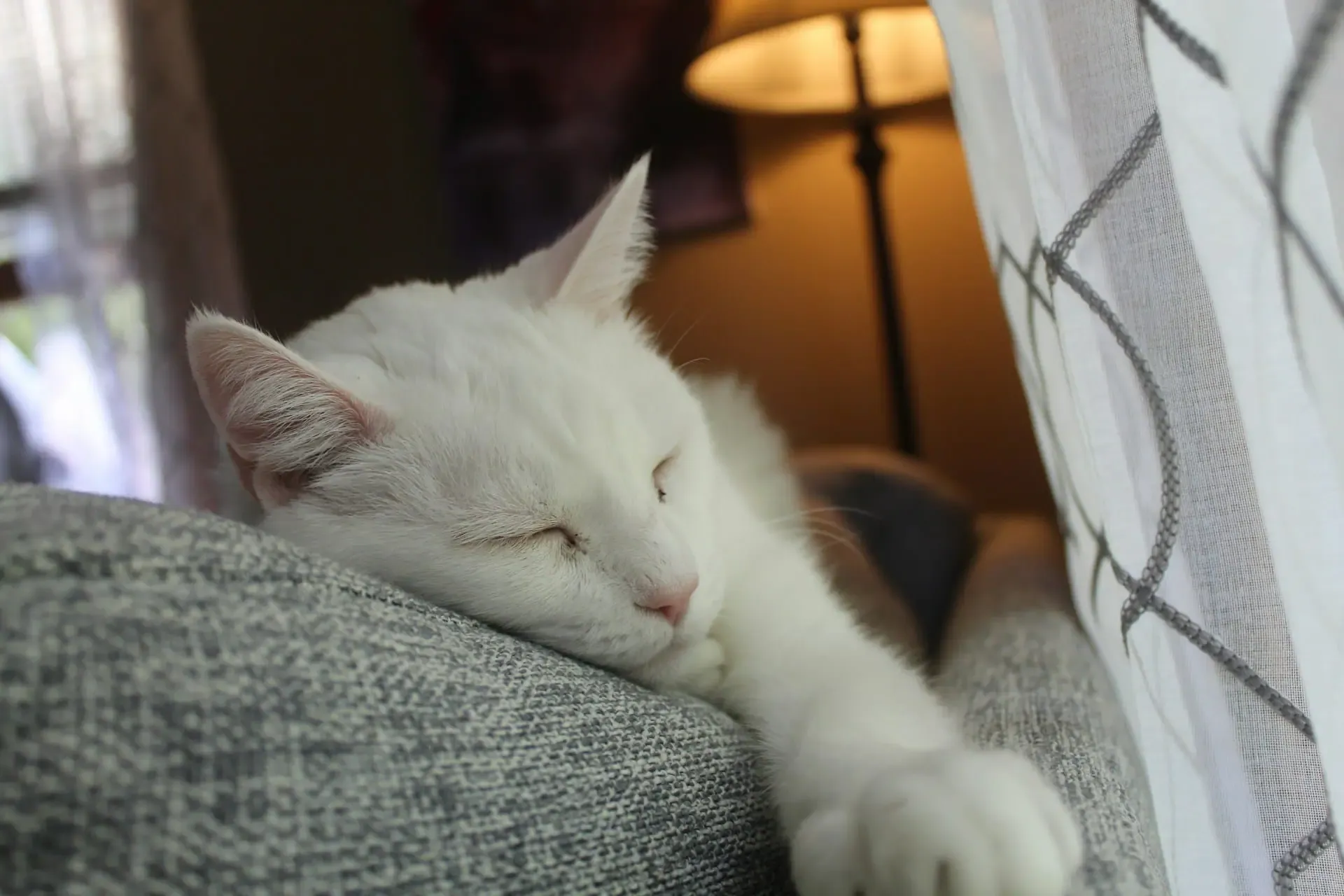
If your cat has been given a diagnosis that isn’t going to be cured, palliative care is the name for everything you do from here. Keeping them comfortable, keeping them eating, keeping them themselves for as long as that’s possible.
Before anything practical, one thing. Agreeing to comfort-directed care isn’t giving up on your cat, whatever the word palliative does to you when a vet first says it. Most people reading this are somewhere between frightened and guilty, and quietly convinced they should be doing more. You’re doing the thing that’s left to do, and it’s a considerable amount.
What nobody warns you about is that cats are hard to nurse. Not because they’re difficult, but because they’re extremely good at concealing the exact thing you’re now watching for. The FDA says as much in its guidance on feline arthritis: cats hide their pain very well. That one fact reshapes everything else.
So this guide is the practical version. How to read a cat who won’t tell you, what changes day to day, how to medicate without a wrestling match, what your cat can’t safely be given, and how to build a routine you can still be doing in six weeks. If you want the definitional groundwork first, our guide to palliative care versus hospice for pets covers the distinction, and our cat end-of-life hub collects everything else in one place. And the grieving you’ve already started while your cat is still here has a name: anticipatory grief.
Key Takeaways
- Palliative care is comfort-directed care for a condition that won’t be cured. It can run for years, and it isn’t a decision to stop trying.
- A cat conceals illness, so most of this is observation. Watch grooming, the litter box, and whether they still jump, because in one study of arthritic cats, fewer than half limped.
- A free, validated tool helps you read pain in a cat’s face, and pet parents scored photographs with it about as reliably as vets did. Take what it tells you to your vet.
- Never give a cat acetaminophen, ibuprofen, or aspirin. Cats can’t process them the way we do, and the consequences are severe.
- Build the routine around what you can sustain. In the research, the strain of the schedule travels with the strain of everything else, so it isn’t trivial admin.
Table of Contents
- 1What Palliative Care for a Cat Is, and What It Isn’t
- 2Why Cats Make This Harder Than Dogs Do
- 3How to Tell Whether Your Cat Is in Pain
- 4Five Things That Change Day to Day
- 5Giving Medication to a Cat Who Doesn’t Want It
- 6The Human Painkillers That Can Kill a Cat
- 7The Conditions That Bring Most Cats to Palliative Care
- 8Building a Routine You Can Actually Keep
- 9How to Track Whether the Care Is Still Working
- 10When Palliative Care Becomes Hospice
- 11What Palliative Care for Cats Really Asks of You
- 12Frequently Asked Questions About Palliative Care for Cats
What Palliative Care for a Cat Is, and What It Isn’t
Palliative care is treatment aimed at comfort rather than cure. Your vet has stopped trying to remove the problem because it can’t be removed. Everything from here targets how your cat feels while they live with it, which means the daily measure of success is your cat’s comfort rather than any test result.
It isn’t a countdown. A cat on comfort-directed care can be a cat who still yells at you for breakfast, and with something like kidney disease, that stretch can be a long one. The word sounds terminal because of how it’s used in human medicine, where it often arrives late. In cats, it often arrives early, and arriving early means there’s more to do.
Nor is it hospice, though the line between them is soft. Hospice generally describes care in the last stretch, with the death expected and planned for. Palliative care is the wider category that hospice sits inside. The comparison guide linked in the introduction takes that apart properly, and “When Palliative Care Becomes Hospice” below covers how you’ll know the shift has happened.
What matters more than the vocabulary is that you’ve become the person closest to the evidence. Not because anyone appointed you, but because you’re the one who’s there.
Why Cats Make This Harder Than Dogs Do
A dog in pain tends to tell you. They limp, they whine, they stop putting weight on the leg. A cat in pain gets quieter, sits differently, and stops doing two or three small things you weren’t consciously tracking. The illness is the same size. The signal is not.
The FDA’s own guidance on feline arthritis makes the point directly: in a study of 28 cats with osteoarthritis, less than half limped but almost three-quarters didn’t want to jump, and two-thirds jumped a shorter distance. The same guidance lists what does tend to show up: weight loss, loss of appetite, decreased activity, a change in attitude, decreased grooming, going outside the litter pan, and not being able to jump as easily as before.
Look at that list for a second longer than feels necessary. Not one of those things looks like pain. Every one of them looks like a cat getting old, or a cat being moody, or a cat being deliberately annoying about the litter box.
What This Changes About Palliative Care for Cats
It means you’re looking for absences, not events. The cat who used to sleep on the windowsill and now sleeps on the floor didn’t develop a new symptom; they lost an old behavior. Those losses are the data.
Write things down, even roughly. The change you’re trying to catch happens across weeks, and nobody holds a baseline in their head that long. Our guide to reading pain in a cat’s body language covers specific postures. But a note on your phone saying “didn’t go upstairs today” is worth more than any of it, because it’s dated and it’s about your cat.
How to Tell Whether Your Cat Is in Pain
There’s a free tool for this, and you may not have come across it. The Feline Grimace Scale scores a cat’s face, and researchers found that five features carry the signal: ear position, orbital tightening, muzzle tension, whisker change, and head position. It was validated against an existing pain instrument, with good agreement between scorers.
What makes it useful to you rather than only to vets is a later study that put it in the hands of pet parents. A survey drew 1,262 completed responses from 66 countries, and the researchers reported that total scores had good reliability when used by cat caregivers. They weren’t significantly different from the scores veterinarians gave on the same images, apart from the muzzle.
Two things to hold alongside it. Everyone in that study was scoring photographs rather than a cat in front of them, and the scale was built for acute pain, so it isn’t a substitute for the longer view of whether life is still good. Use it as one reading among several, and take it to your vet rather than acting on it alone.
The Two-Week Photograph
Take a photo of your cat’s face, in the same light, every couple of weeks. Comparing one photo to another is far easier than comparing today to a memory from March, and ear position in particular tends to be obvious side by side when it was invisible day to day.
It’s worth doing the same with something that isn’t their face. A shot of them in their usual spot, taken from the same doorway, catches posture changes you’d otherwise miss: a cat sitting hunched rather than curled, or with their feet tucked differently, or an inch further from the radiator than they used to settle.
Keep them in one album so you don’t scroll past everything else to find them. Two minutes every couple of weeks, and you end up with the only real record of this stretch that will ever exist.
Five Things That Change Day to Day
Almost every practical decision in feline palliative care lands in one of five places. If you’ve been wondering what you’re actually supposed to be doing all day, the answer is mostly these.
Appetite
Appetite is often where this starts, and it’s what frightens people most. Warm the food slightly, because most cats eat better when it smells stronger, and warming is the simplest way to do that. Offer smaller amounts more often rather than a full bowl that goes stale, and try putting the bowl where your cat already is instead of making them travel to it.
A cat who turns away from food they liked last week may be nauseous rather than uninterested, and nausea is treatable, so describe exactly what happens: whether they approach and then back off, whether they lick at it and leave it, whether they’re drooling. Those details point somewhere.
One firm line. A cat who hasn’t eaten anything for a day needs a call to your vet that day, not an overnight wait to see how they are in the morning. Not eating is its own problem in cats, on top of whatever caused it: the Merck Veterinary Manual notes that anorexia or food deprivation sets the stage for hepatic lipidosis, a liver condition cats are prone to. So this is a place to be the person who rings too early rather than too late.
Hydration
Cats are poor drinkers at best. Multiple water bowls away from the food, a running fountain, and wet food all help. For kidney patients, many vets will teach you to give fluids under the skin at home, and Cornell’s feline health center notes that many pet parents can learn to perform this at home with guidance from their veterinarian. It sounds impossible until somebody shows you how, and plenty of people who were certain they’d never manage it end up doing it without much thought. Your vet sets the schedule. If it turns out not to be for you, say so early rather than dreading it, because there are other ways to get fluids into a cat.
The Litter Box
A cat who’s suddenly going outside the box is almost certainly not being spiteful. Sometimes the box has become hard to climb into, or hard to reach in time, and that’s a mobility problem you can solve with furniture.
But it can equally be the illness itself. Kidney disease changes how much a cat urinates, and urinary problems, infections, and several other conditions all change toilet habits. So a new change means a call to your vet as well as a rearrangement, and if your cat is straining, going repeatedly, or producing nothing at all, that’s an emergency the same day rather than something to watch. Tell your vet what changed and when it started.
Make it easier regardless. Cut a lower entrance into one side, put a box on every floor they use, and take the lid off so there’s nothing to climb through.
Warmth and Rest
Thin, older, unwell cats get cold. Soft bedding somewhere out of the draft helps, and so does a ramp or a stool up to whatever they used to jump onto, which buys back a piece of ordinary life.
Watch where they choose to sleep. A cat who gives up a high perch is often telling you that getting up there now costs more than the view gives back. Tell your vet, because that’s the kind of change that turns out to have a physical cause more often than pet parents expect.
Grooming
A coat that turns greasy or matted can mean grooming has stopped, and decreased grooming is on the FDA’s list of feline arthritis signs. Talk to your vet rather than just brushing it out. Reaching may have become difficult, or nausea may be putting them off it, so it’s a symptom, not a grooming lapse.
Brush them anyway. It’s practical, and it’s one of the few parts of this that feels like affection rather than nursing.
Giving Medication to a Cat Who Doesn’t Want It
This is where good plans quietly fall apart, and it’s the most common thing pet parents tell us they feel bad about. A schedule that needs you to physically overpower your cat twice a day tends not to survive week three. Nobody fails at this through weakness of will. The schedule was built wrong, and you can rebuild it.
Say this out loud to your vet: “I don’t think I can pill them twice a day.” Your vet needs to hear it, because the plan usually has more flexibility than you’d think.
Ask What Comes as a Gel
Some feline medications can be given through the skin instead of the mouth. Mirtazapine, an appetite stimulant, is the clearest example. In a placebo-controlled trial in cats losing weight, an ointment applied to the inside of the ear produced a mean body weight change of +3.9% against +0.4% on placebo. A separate crossover study in cats with kidney disease found increases in appetite and weight, and also noted that some individual cats became notably vocal on it.
Those were short studies in small groups, so treat this as a conversation to have rather than a result to expect. But the principle stands: rubbing something into an ear is a fundamentally different daily event from getting a tablet down a cat.
The Vet Trip Itself
Palliative care means more appointments for an animal who finds the carrier traumatic. Decent evidence suggests you can take the edge off. In a randomized crossover trial of twenty healthy cats known to hate the vet, those given gabapentin before a visit had significantly lower stress scores during transport and examination than the same cats on placebo. Sedation was the common effect, and some cats were wobbly on their feet, drooled, or vomited. All of it had worn off within eight hours.
One thing to be clear about: what was measured there was stress on the journey and in the room, not pain. If it comes up, ask your vet which of the two they mean for your cat.
The Human Painkillers That Can Kill a Cat
If you take one thing from this page, take this one. Don’t give your cat anything from your medicine cabinet, including things that seem mild.
Acetaminophen, sold as paracetamol or Tylenol, is the most dangerous. The MSD Veterinary Manual explains that cats are especially susceptible because they have low glucuronyl transferase activity and therefore have limited capacity for glucuronidation. In plain terms, the enzyme system people use to make that drug safe barely functions in a cat. The same manual lists lethargy, loss of appetite, weakness, vomiting, low body temperature, swelling of the face or paws, and difficulty breathing among the signs.
Ibuprofen isn’t a safe alternative. The same source notes cats are affected at roughly half the amount it takes to poison a dog, for the same metabolic reason. Cats also tolerate aspirin poorly.
What Vets Can Prescribe, and Why It’s Different for Cats
The anti-inflammatory situation in cats is genuinely different from the one in dogs, and it’s worth understanding before it worries you. The FDA states, in the same feline arthritis guidance cited earlier, that no veterinary NSAIDs are currently approved for safe, long-term control of pain and inflammation due to osteoarthritis in cats. Dogs have approved options for exactly that.
Cats do have something, just not an NSAID. The FDA has approved a monoclonal antibody injection for controlling osteoarthritis pain in cats, given at the practice, which dampens the pain signal rather than the inflammation. If your cat has arthritis and nobody has raised that option, it’s fair to ask about it.
Vets also prescribe anti-inflammatories to cats carefully and legitimately, outside the terms of an approval, and that’s a normal, regulated part of veterinary practice rather than a corner being cut. If your cat is on a prescribed pain medication, none of this is a reason to stop it on your own. It’s a reason to ask, at the next ordinary appointment, what the monitoring plan looks like, because long-term pain control in a cat is generally something vets keep an eye on rather than set and forget.
Separately: if something about the medication worries you, or your cat seems unwell on it, don’t wait for the next appointment. Ring your vet, and be ready for them to want to stop it.
If you think your cat has swallowed any human painkiller, that’s an emergency now, not in the morning.
The Conditions That Bring Most Cats to Palliative Care
These are the four you’re most likely to be dealing with, and which one you’re facing tells you what the daily work will actually be.
Chronic Kidney Disease
This is the big one. In a study of cats randomly selected across four age bands from a feline-only practice, chronic kidney disease was found in around 42% of cats aged 10 to 14, rising to about 81% of cats aged 15 to 20. Cornell’s figures are close to identical. Those numbers include early-stage disease picked up on screening rather than cats who are visibly ill, so it isn’t a finding that four in five old cats are in kidney failure.
Day to day, kidney care is about hydration, appetite, and nausea, and it tends to be a long game rather than a short one. Ask your vet which stage your cat is at, because the answer changes what you’re watching for.
Arthritis
Badly underdiagnosed, for all the reasons in “Why Cats Make This Harder Than Dogs Do” about cats not limping. One radiographic study of 101 cats whose pet parents had specifically asked for arthritis screening found degenerative joint disease in the limb joints of 74%. That was a group already suspected of having it, so it isn’t a general-population rate. It shows how much is there once somebody actually looks.
The daily work for arthritis is mostly furniture. Steps or a ramp to the places they still want to reach, a bed they don’t have to jump down from, food and water at a height that doesn’t need a stretch, and a litter box with one low side. None of that is medical, and it buys back movement your cat has been quietly giving up.
Then ask your vet about pain control specifically, using the word pain rather than stiffness or slowing down, because those get heard very differently.
Hyperthyroidism
This one is on the list for the opposite reason to the others. Cornell’s Feline Health Center says hyperthyroidism is a common disease in cats, and mostly afflicts cats middle-aged and older, with weight loss, increased appetite, and increased thirst and urination among the usual signs. It’s often treatable rather than only manageable, and radioactive iodine treatment frequently cures it outright.
That makes it one of the diagnoses most worth ruling out before anyone settles into comfort-directed care. If your cat is losing weight while eating well, ask whether the thyroid has been checked recently.
It turns palliative when treatment isn’t possible or isn’t tolerated, or when it sits alongside something else that isn’t going away. Your vet can tell you which of those you’re in. Either way, the day-to-day work comes down to weight and appetite, which is the Appetite section above.
Cancer
Cancer varies too much for any guide to tell you what this will look like for your cat, and anyone who says otherwise is guessing about an animal they’ve never met. What does generalize is the shape of the questions. Ask what this specific plan is aimed at, whether it’s buying comfort or time or both, and what the next decision point is likely to be, so you don’t meet it cold.
Ask as well what a bad stretch would look like, because recognizing one takes most of the panic out of it. Our guide to common diseases in senior cats has the symptom patterns.
And when nobody can give you a timeline, which is often, the thing left to do is the thing you were already doing: watch your cat, not the calendar.
Building a Routine You Can Actually Keep
If the admin of this is grinding you down, that’s not a personal failing, and it has been measured. Pet parents of sick animals, compared with matched pet parents of healthy ones, reported greater caregiver burden, more symptoms of depression, anxiety and stress, and poorer quality of life. The useful part is what the burden turned up alongside. The treatment-plan factors associated with it were changes in routine because of the animal’s condition, and the perception that following new rules and routines was challenging.
That was a snapshot, not a study that followed people over time, so it can’t tell you which way the arrow points. What it does tell you is that logistics and distress show up together, which matters if you’ve been treating the schedule as the easy administrative part. For a lot of people it’s the hardest part.
Which has a practical consequence. When your vet proposes a plan, the right question isn’t only whether it’s the best possible care. It’s whether you can still deliver it in six weeks at seven in the morning on a day when work is bad. A slightly smaller plan you keep beats an ideal plan you abandon, and most vets would much rather build the first one with you than find out later that the second one was never going to work.
Some of it can also be shared. Pet parents tell us the medication schedule is the single easiest thing to hand to somebody else in the house, and the one they hand over last.
How to Track Whether the Care Is Still Working
The question underneath all of this is whether your cat’s life is still good, and it’s the one nobody else can answer for you. What helps is refusing to answer it in your head at midnight, off a feeling. Put it somewhere you can look at over time instead of deciding it in one bad hour.
Score it instead. Pick three or four things that are specifically true of your cat, not a generic list: whether they came downstairs today, whether they finished a meal, whether they sat with you, and how the grooming looked. Mark each one daily. No single day tells you much. Two weeks of marks show you a direction, which is the whole point of writing any of it down.
Our daily feline quality-of-life checklist is a structured version of exactly this if you’d rather not build your own, and it’s the tool to bring to a vet conversation, because “she’s been quieter” is hard to act on and two weeks of marks is not.
One more thing, plainly. Good days will keep happening, including some very good ones, and a good day isn’t evidence that the trend has reversed. Both are true at once, and the checklist is how you hold them both.
When Palliative Care Becomes Hospice
No one tells you the moment it changes. What generally happens is that the goal quietly shifts from managing a condition over months or years to making a much shorter stretch as good as it can be. You often notice the shift has already happened rather than watching it arrive.
Signs the conversation is due: the interventions that worked have stopped working, the bad days now outnumber the good ones on your own tracking, or you find you’re treating your cat’s distress more often than you’re enjoying your cat. That last one isn’t a failure of nerve. It’s information.
Our guide to how pet hospice works and when it’s the right choice covers what that transition involves, and our directory of in-home euthanasia providers is there if you reach the point of wanting it to happen at home, on your cat’s own furniture, without a car ride they hate.
You don’t have to know today. Ask early anyway, because it gives you the ability to choose rather than react.
What Palliative Care for Cats Really Asks of You
Palliative care sounds clinical, and almost none of what you’ll actually do is. Warming food. Moving a litter box downstairs. Noticing that the ear position looks different from a photo you took two weeks ago, and telling somebody who can act on it.
What you’re giving a cat who conceals everything is somebody who knows them well enough to notice anyway. Not perfectly, and not every time. But you’re the one who knows which windowsill is theirs and what they sound like on a good morning, and that knowledge is the whole instrument.
Do it in a way you can sustain. Ask for the version of the plan that fits your actual life, hand pieces of it to other people, and let some days be worse than others without treating that as evidence you’re failing. None of that is paperwork wrapped around the care. That’s the care.
Frequently Asked Questions About Palliative Care for Cats
How long can a cat live on palliative care?
There’s no single answer, and the honest version is that it varies enormously by condition. Some cats are diagnosed with kidney disease at a routine screening appointment while they’re still behaving completely normally; other diagnoses move much faster. Your vet is the only person who can give you any range for your cat, and even then it’s a range. What comfort-directed care is aimed at is how the time feels rather than how much of it there is, so try to resist scoring it against a number somebody quoted you. The more useful question to ask your vet is what the next likely change is and what you’d do about it, because that gives you something to prepare for rather than a countdown to watch. Ask that question again every few weeks, since the honest answer shifts.
Can I give my cat human pain medication if I use a small amount?
No, and the amount isn’t the protective factor people assume it is. Cats lack much of the enzyme capacity that lets humans process acetaminophen safely, which is why the margin is so unforgiving compared with what you or a dog could tolerate. Ibuprofen carries the same problem for the same metabolic reason, and aspirin is poorly tolerated too. No household painkiller becomes safe at a small enough dose, and if your cat shows lethargy, vomiting, swelling of the face or paws, or labored breathing after any of them, see a vet immediately rather than waiting overnight. If your cat is in pain right now and you have nothing prescribed, the answer is an emergency vet, not the medicine cabinet.
How do I know if my cat is in pain or just getting old?
You mostly can’t tell them apart by watching for pain, because a cat in pain doesn’t act in pain. What you can do is track function. Are they still getting to the places they used to get to, still grooming to the same standard, still using the litter box reliably, still finishing meals? A decline in those is the signal, whatever the underlying cause. The Feline Grimace Scale gives you a second, more structured reading, and it’s free to look up. Bear in mind it was built to measure sudden pain rather than the slow grind of a chronic condition, so it answers a narrower question than the one you’re asking. Neither approach replaces a vet, but arriving with two weeks of specific observations changes the appointment completely.
My cat hates being medicated. What are my options?
Ask your vet directly, because the plan can usually be changed, and a plan you quietly abandon helps nobody. Ask what’s available as a transdermal gel rubbed into the ear rather than a tablet, since some feline medications come that way and appetite support in particular has a version that’s been through a proper trial. Longer-acting injections given at the practice are worth raising too. It’s also fair to ask whether anything on the current list is optional or could be reduced, and what actually happens if a dose gets missed, because knowing that removes a lot of the dread. If the fight itself is the problem, that’s a clinical issue to solve, not a personal shortcoming to push through.
Is palliative care just delaying the inevitable?
The question underneath that one is usually whether comfort still counts for anything once the outcome is fixed, and it does. What you’re doing right now is producing a life your cat can still recognize as theirs, which is the same thing you were doing when they were well and nobody called that a delay. The honest boundary is elsewhere: palliative care becomes something else when it stops adding comfort and the days start getting through rather than being lived. You’ll usually feel that before you can argue it. When you do, take it to your vet as a question rather than a decision, because they’ve watched this happen many times and you’re watching it once.
On this topic