







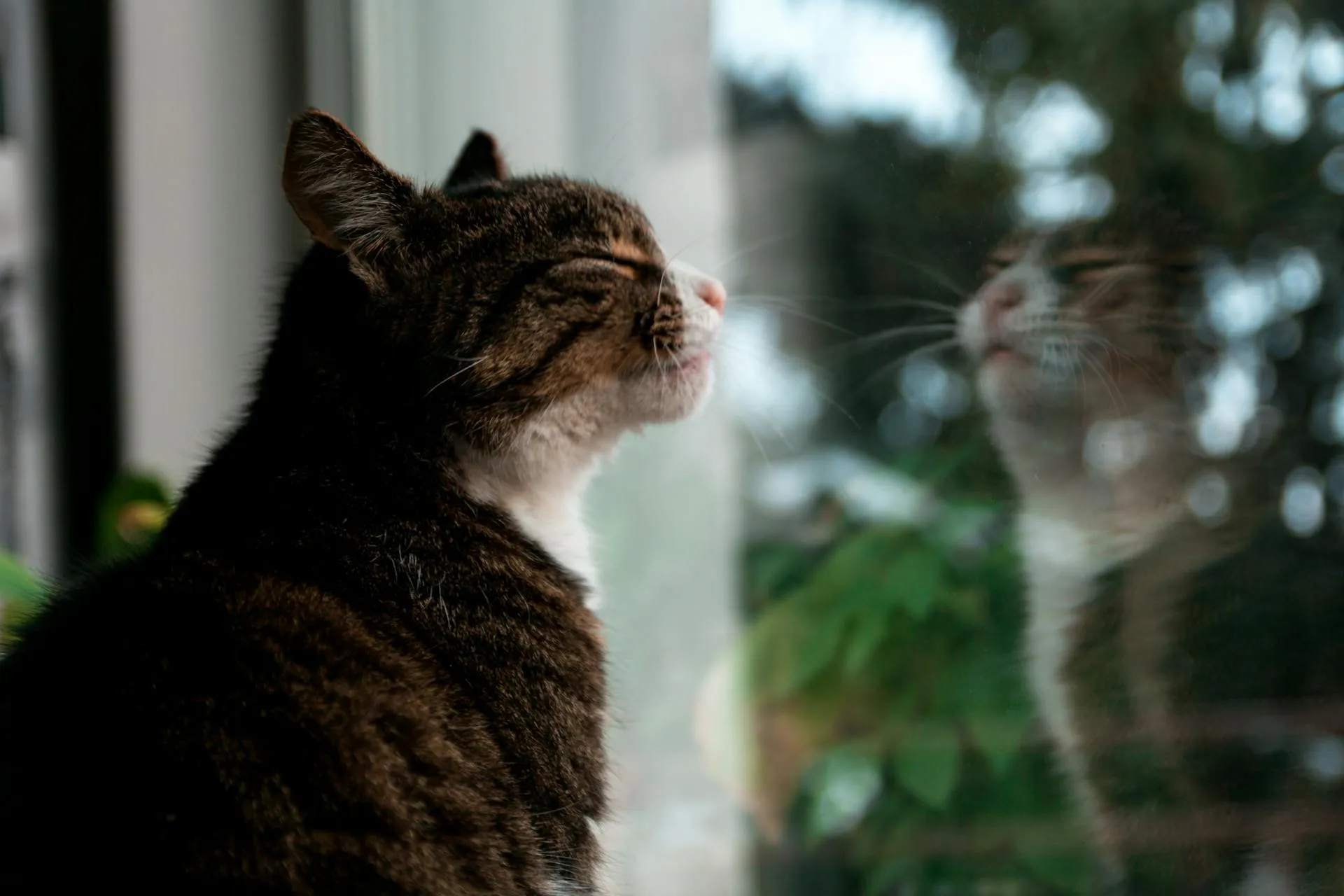
If you’ve lived with a cat, you’ve probably had a moment. Maybe it was 3 a.m. when your cat appeared in the doorway of your bedroom, exactly when you woke up in panic. Or the afternoon your cat sat on your lap for hours without prompting, sensing something was wrong before you said anything. Or the time your cat did something so peculiar, so perfectly timed, that you couldn’t explain it through simple behavior.
These moments make you wonder. Is there something in my cat that’s more than neurons and instinct? Do they know me in a way that goes beyond learning and conditioning? And if they do, if they have something like a soul, where does that soul go when they die?
Cat parents often hesitate to ask this question out loud. Cats have a reputation for indifference, for being transactional and untouched by sentiment. But if you’ve loved a cat, you know this reputation is incomplete. Cats forge real bonds. They grieve. They have preferences, humor, complicated inner lives. And when you lose one, something irreplaceable is gone.
The question of whether your cat has a soul is, really, a question about whether what you shared was real. Whether that bond mattered. Whether your grief makes sense.
The honest answer is that science and faith don’t speak with one voice on this question. But both have something to teach you about your cat’s inner world and what makes your relationship with them matter.
Key Takeaways
- Science confirms that cats have measurable consciousness, complex emotions, individual personalities, and the neurological structures that support awareness and attachment.
- The 2012 Cambridge Declaration on Consciousness acknowledged that animals possess subjective experience, directly contradicting older assumptions that they lack inner lives.
- Different faith and spiritual traditions hold varying views on cat souls, from ancient Egypt’s reverence for cats as sacred beings to contemporary theological perspectives.
- Cats’ unique way of showing love and connection, different from dogs, but no less real, makes the bond with them distinctive and spiritually significant.
- Your experiences after losing a cat, whether dreams, a sense of presence, or continued connection, are part of how humans process profound loss across cultures.
Table of Contents
- 1Why We Wonder About Our Cat’s Soul
- 2What Science Says About Cat Consciousness
- 3Ancient Egypt and the Sacred Status of Cats
- 4Christian Views on Whether Cats Have Souls
- 5Islamic and Jewish Perspectives on Animal Souls
- 6Buddhism, Hinduism, and the Spirit of Cats
- 7Indigenous Traditions and Animal Spirituality
- 8What Cat Owners Experience After Losing a Cat
- 9The Rainbow Bridge and What It Means to Cat Owners
- 10Frequently Asked Questions About Cats and Souls
Why We Wonder About Our Cat’s Soul
Cats evoke a particular kind of spiritual questioning. There’s something about the way they move through the world, so present and yet so private, that makes you wonder what’s happening inside.
If you’ve watched your cat slowly blink at you and felt it as a gesture of trust and affection, you’ve experienced something that modern cat science would call intentional communication. If your cat has sat with you through illness or grief without being asked, you’ve experienced something that feels like empathy or at least attentiveness. If your cat has done something at exactly the right moment, something that seemed to respond to your emotional state, you’ve sensed that they know you.
Cats aren’t as demonstrative as dogs. They don’t follow you around. They don’t perform affection theatrically. But the bond with a cat is often no less intimate; it’s just expressed differently. A cat who chooses to be in your room is choosing you. A cat who kneads your chest is offering you something real. A cat who shows up when you cry is present in a way that goes beyond stimulus and response.
The spiritual question arises because the relationship is so real. You’ve been changed by knowing your cat. They’ve influenced how you understand patience, independence, presence, and boundaries. They’ve made you laugh. They’ve comforted you. When they die, you’re not mourning a pet the way you might mourn a possession. You’re mourning a being whose absence creates a genuine hole in your life.
So you ask: Does my cat have a soul? Is what I felt real? Will I see them again? Did they know, in some deep way, that I loved them?
These questions matter. And there are richer answers than you might expect.
What Science Says About Cat Consciousness
For much of the 20th century, scientists approached animal consciousness with skepticism bordering on dogma. Animals were thought to lack inner experience, to operate entirely on instinct and conditioning. But this framework has collapsed in the face of evidence.
The most important moment in modern animal consciousness research came in 2012, when a group of prominent neuroscientists gathered at Cambridge University to formalize what accumulating evidence had been suggesting. They signed the Cambridge Declaration on Consciousness, which acknowledged that non-human animals possess consciousness and awareness. Specifically, the declaration stated that animals have the neurological substrates that generate consciousness.
This sounds academic, but it’s actually revolutionary. It means that science now officially recognizes what your experience with your cat already told you: they’re experiencing something. They’re aware. They’re not an automaton.
Research on cat cognition has documented impressive capacities. Cats have long-term memory. They remember events from years ago and adjust behavior based on past experience. They solve problems. They understand cause and effect. They read human facial expressions and respond differently to different emotional displays. A cat can tell when you’re sad or upset, and there’s evidence that at least some cats modify their behavior in response, seeking you out, staying close, changing how they interact with you.
Cats show evidence of what researchers call object permanence. They know that things that disappear from sight still exist. They can remember where food is hidden. They anticipate events and plan behavior accordingly. More philosophically interesting: cats seem to understand that you know things they don’t and that you might notice things they do. This capacity, called theory of mind, was long thought to be uniquely human.
Cats have distinct personalities that persist over the years. One cat is cautious, another bold. One cat is cuddly, another aloof. This isn’t just different conditioning; it reflects different fundamental temperaments, different ways of being in the world. Your specific cat, with their specific personality and preferences, has a consistent self that continues over time.
Emotionally, cats display what appears to be joy, anxiety, fear, contentment, and grief. They respond to loss. When a cat they live with dies, the surviving cat often changes behavior dramatically, becomes withdrawn, loses appetite, and shows signs of distress. This isn’t learned behavior from watching a dead body. It’s a genuine emotional response to absence.
Cats form attachments. Research has shown that cats use their owners as a secure base for exploration (they venture further from you if they trust you, knowing they can return). They show signs of separation anxiety. They greet returning owners differently from how they greet strangers. They remember people individually and show differential treatment based on past interactions.
All of this builds a picture: your cat is conscious. They’re aware. They have emotions. They form real attachments. They’re not simple stimulus-response organisms or robotic creatures driven by instinct. They’re beings with an inner world.
Now, does this prove cats have souls? Not in the traditional metaphysical sense. Science can’t measure souls. But it does prove that what it means to have a soul in the deepest sense is something your cat possesses. The consciousness you perceive in your cat is real. The awareness they’re displaying is genuine. The bond you share is mutual and meaningful at a neurological level.
Ancient Egypt and the Sacred Status of Cats
To understand how humans have historically understood the cat’s spiritual nature, it’s worth looking back to ancient Egypt, the civilization that perhaps came closest to definitively answering the question of the soul: yes, cats have souls, and they’re sacred.
Cats were venerated in ancient Egypt in ways that go beyond practical value. Yes, cats were useful for controlling rodents. But the reverence for cats went far deeper. Killing a cat, even accidentally, could result in execution. Cats were mummified with elaborate ritual and buried in sacred cemeteries. Entire cat cemeteries have been discovered in Egypt, containing thousands of cat mummies, some placed with artifacts and offerings, suggesting they were believed to be on a spiritual journey requiring provision.
The goddess Bastet, one of the most important deities in the Egyptian pantheon, was depicted as a cat (or a human with a cat’s head, depending on the period). Bastet represented protection, fertility, motherhood, and divine power. To harm a cat was to invite divine wrath. To care for a cat was to honor the goddess.
What’s remarkable about the Egyptian view is that it wasn’t based on scientific proof. It was based on recognizing something spiritually. The ancient Egyptians saw cats as bearers of divine essence. Their grace, their confidence, their seeming indifference to the merely material, the way they could see things humans couldn’t perceive: all of this was understood as evidence of spiritual presence.
This civilization didn’t debate whether cats had souls. They took for granted that they did, and treated them accordingly. The question for an ancient Egyptian wasn’t “Is this cat conscious?” It was “how do we properly honor the sacred being we live with?” Across spiritual traditions, this reverence for animal souls has been consistent.
Christian Views on Whether Cats Have Souls
Like Christianity’s teaching on dog souls, its approach to cats is complicated and has evolved significantly. The same theological questions that apply to dogs emerge when we ask what Christianity says about pets in the afterlife.
Historically, mainstream Christian theology followed the Aristotelian framework, assigning animals to a category of beings without rational souls. Thomas Aquinas codified this teaching, arguing that animals possess sensitive souls (capable of sensation and emotion) but not rational souls (capable of abstract thought and moral reasoning). Therefore, animals lack immortality, and consciousness ceases at death.
This teaching established a clear boundary between humans and animals, between the immortal and the mortal, reinforcing human dominion and uniqueness in God’s eyes.
But there were always dissenting voices. Augustine, Francis of Assisi, and other early Christian figures expressed deep care for animals and suggested that their souls mattered. In medieval times, some theologians argued that animals, particularly those with whom humans shared intimate relationships, might have a form of spiritual existence.
In contemporary Christianity, especially among Catholic and progressive Protestant thinkers, the view has softened considerably. Pope John Paul II suggested that animals have souls. Pope Francis’s 2014 comments appeared to affirm that animals go to heaven, though this was framed as a pastoral reflection rather than official doctrine. Among modern theologians, there’s an increased willingness to question whether the traditional boundary between human and animal consciousness is as clear-cut as medieval theology suggested.
Some contemporary Christian thinkers argue that God’s care for creation, evident throughout Scripture, from God noticing the fall of sparrows to Jesus driving demonic spirits into pigs rather than destroying them outright, suggests that animals have spiritual significance. If God cares deeply for animals during their lives, why would God discard them completely at death?
Other Christian voices hold more traditional views, maintaining that while animals matter morally, they lack the immortal souls that humans possess. But even within this framework, the consensus has shifted toward the recognition that animal consciousness is real and that our moral responsibility to animals is binding.
The honest answer: Christianity doesn’t have one voice on this question. But the historical trend is toward greater recognition of animal consciousness and spiritual value.
Islamic and Jewish Perspectives on Animal Souls
In Islamic tradition, the treatment of cats has been shaped by the Prophet Muhammad himself, who is recorded in numerous hadith as showing exceptional care toward animals. Most famously, he’s reported to have loved cats and once cut off his sleeve rather than disturb a sleeping cat. This isn’t incidental; it’s part of Islamic teaching on animal welfare.
In Islam, animals are understood not as objects for human use but as communities parallel to human communities. The Quran states explicitly: “There is not an animal on earth, nor a bird that flies on its wings, but they are communities like you.” This phrasing suggests that animals have structured social existence, purpose, and standing before God.
Islamic teaching emphasizes human accountability for the treatment of animals. The Prophet Muhammad is reported to have praised a woman who gave water to a thirsty dog, saying the act was significant enough to earn her entry into paradise. Conversely, Islamic tradition records stern warnings against cruelty to animals, with the Prophet reportedly saying that a woman was punished in the afterlife for neglecting to feed a cat.
The Islamic concept of animal souls is less developed than the concept of animal moral standing. Traditional Islamic theology doesn’t clearly address whether animals have immortal souls or what happens to them after death. But the implication is clear: animals matter. Their suffering creates moral obligation. Their welfare is a divine concern.
Judaism similarly emphasizes care for animals as a religious obligation. The concept of tza’ar ba’alei chayim (the suffering of living creatures) is a foundational ethical principle. In Jewish law, you have actual obligations to animals; you must feed your animals before you feed yourself, you cannot cause unnecessary suffering, and you must allow animals to rest on the Sabbath as humans do.
In Hebrew, the word nefesh (often translated as soul) applies to both human and animal life. The same term is used for the animating principle in both humans and animals in Genesis. This linguistic continuity suggests that in ancient Jewish understanding, animals and humans weren’t categorically different in having souls; they were continuous.
Different Jewish theological traditions have varying interpretations of animal afterlife and immortality. But the foundational principle is consistent: animals possess something we might call a soul or spiritual essence. They matter. Their treatment matters. They’re not mere objects.
Buddhism, Hinduism, and the Spirit of Cats
In Buddhist and Hindu philosophy, the question of whether cats have souls is answered immediately and affirmatively.
Buddhism teaches that all sentient beings possess consciousness and Buddha-nature. In fact, Buddhism goes further than Western thought typically does; it suggests that the capacity for enlightenment isn’t uniquely human. An animal might be born as a cat in this lifetime but could be born as a human in another, or progress spiritually in ways humans don’t recognize.
In this framework, your cat’s soul is real and eternal, though it might be experiencing a particular form of consciousness specific to being a cat. The cat’s awareness, their ability to feel joy and fear, their capacity for affection or indifference: all of this is evidence of consciousness that Buddhist philosophy would recognize as equally real as human consciousness, even if expressed differently.
Importantly for cat owners: Buddhism teaches that the bond between you and your cat might extend beyond this lifetime. If your cat’s consciousness continues through rebirth, you might encounter them again, or the karmic connection between you might influence future encounters. The relationship doesn’t end at death; it transforms.
Hinduism similarly affirms that all animals possess the Atman: the eternal self or soul. In Hindu philosophy, the same soul that’s experiencing life as a human in one lifetime might experience life as a cat in another. This isn’t a demotion or punishment, just a different expression of the same eternal consciousness.
The Bhagavad Gita teaches that souls are indestructible and eternal. The body changes, forms change, but the soul (atman) continues. A cat’s soul, in this understanding, is as real and eternal as a human’s. What changes is the form, not the consciousness itself.
From both Buddhist and Hindu perspectives, your relationship with your cat involves a real meeting of souls. The bond you share is karmically significant. And when your cat dies, what ends is their expression in physical form, not their existence or their connection with you.
Indigenous Traditions and Animal Spirituality
Across many Indigenous cultures worldwide, animals are understood to possess their own forms of consciousness, agency, and spiritual significance. Rather than asking “do cats have souls?” the framework itself is different. The question is “what can we learn from the cats we encounter?” and “what spiritual gifts does the cat bring?”
In many Indigenous traditions, cats (like other animals) are understood not as lesser beings but as other nations, other peoples with their own purposes and wisdom. A cat isn’t something you own; it’s a being you’re in a relationship with. The relationship flows in both directions.
Many spiritual traditions teach that animals serve as guides and teachers. A cat who comes into your life isn’t random; in these frameworks, the meeting itself is spiritually significant. The cat’s characteristics (independence, presence, the ability to see in darkness, and grace despite danger) are understood as spiritual teachings available to you.
In animistic frameworks, which appear in many Indigenous traditions globally, consciousness isn’t something unique to humans or even to animals with brains. Consciousness is understood as a basic feature of existence. Rocks have a form of consciousness. Water has presence. A cat, especially one you’ve bonded with, has an individual spirit and a unique presence.
In these frameworks, when your cat dies, their spirit doesn’t cease to exist. It transforms. It may continue to offer guidance, comfort, or teaching. Many people across cultures report that they continue to feel their cat’s presence, receive messages through dreams, or experience their ongoing influence in their lives. Within spiritual traditions, these experiences are understood as real and valuable forms of continued relationship.
What Cat Owners Experience After Losing a Cat
Grief for a cat is often treated as if it should be less intense than grief for a dog. Cats are thought to be more distant, less attached, and easier to replace. But people who’ve actually lost a cat know this is wrong. Understanding the stages of grief after a cat dies can help you recognize that what you’re experiencing is valid.
Cat owners report the same constellation of grief experiences as any person losing a beloved companion. Some report vivid dreams of their cat, often with a presence that feels different from that of dreams about other things. The cat appears healthy, sometimes seemingly aware of the dreamer’s grief. These dreams often leave people with a sense of comfort or peace.
Many cat owners report experiencing their cat’s presence in the physical space they share. A feeling of weight on the bed at night in the exact spot where the cat always slept. A shadow that moves like their cat moves. The unmistakable sensation of the cat brushing against their leg. These experiences come without warning and often bring both a surge of grief and a strange reassurance.
Cat owners frequently report that their cat’s presence seems most intense at moments of emotional struggle. Times when they’re crying, when they’re making difficult decisions, when they’re feeling lost. In these moments, many report sensing their cat’s presence, sometimes interpreting it as the cat checking in on them, continuing the relationship in a different form. If you’re overwhelmed by grief after your cat’s death, pet loss grief counselors specialize in helping you navigate these experiences.
A pattern researchers call “continuing bonds” is especially common among cat owners. Rather than moving past their cat’s death, they maintain an active relationship. Some seek animal communicators or mediums to continue a spiritual connection. They talk to their cat about daily events. They ask for guidance when facing decisions. They visit the place where the cat’s ashes are kept. They keep the cat’s belongings or create a space to remember them. The reality that grief over pet loss is normal validates these continuing bonds as part of healthy mourning.
These practices aren’t considered signs of pathology or inability to move on. They’re part of healthy grieving that honors the relationship and integrates the loss into a person’s ongoing life. Your cat shaped you. That influence continues.
The Rainbow Bridge and What It Means to Cat Owners
The Rainbow Bridge is a contemporary spiritual concept that holds special significance for cat owners, though it’s sometimes dismissed as kitsch. But dismissing it misses something important about what it represents.
The Rainbow Bridge concept appears in various spiritual traditions and has been woven into modern pet loss culture. The image suggests that when a beloved animal dies, their spirit goes to a beautiful place: a bridge between the physical world and something beyond. In this place, pets are restored to health and youth. They’re happy. And they wait.
The idea is that one day, when the human who loved them also dies, they’ll be reunited at the bridge. The bond will be restored. The separation is temporary.
Now, is the Rainbow Bridge literally real? That’s not the point. What matters is what the concept does for grieving pet parents. It provides language for something people feel: that the relationship persists, that the cat matters eternally, that reunion is possible. It honors the bond as something significant enough to survive death.
For cat owners specifically, the Rainbow Bridge has taken on additional meaning. Cats, in cultural imagination, exist slightly outside normal time and space. They see things humans don’t. They move through physical reality with otherworldly grace. Imagining them on a bridge between worlds feels right. It honors their particular nature.
Whether or not you believe in the Rainbow Bridge literally, the image works: it lets you imagine your cat is okay, that they haven’t ceased to exist, that your love for them continues to have meaning.
Frequently Asked Questions About Cats and Souls
If science can’t prove cats have souls, should I accept that they don’t?
Science isn’t designed to prove or disprove the existence of a soul. That’s not a limitation of science; it’s simply outside its scope. What science can tell us is that cats are conscious, that they experience pain, pleasure, fear, and affection. They form emotional bonds. They grieve. They show preferences and make deliberate choices. Whether that constellation of inner experience constitutes a soul depends on how you define the word, and that’s a philosophical and spiritual question, not a scientific one. Not believing in souls because science hasn’t confirmed them is a reasonable position. So is believing in them for reasons unrelated to scientific proof. The more useful question may be: what do you actually believe, and does that belief bring you comfort or take it away?
Will I ever see my cat again after they die?
No one knows for certain, and anyone who tells you otherwise with complete confidence is speculating. What exists are traditions, beliefs, and personal experiences, some of which are quite moving. Many religious and spiritual traditions hold that animals are part of an afterlife in some form, even if the specifics vary widely between them. Others believe consciousness ends at death and that’s the whole of it. Many people who have lost cats report a profound sense of their cat’s continued presence in the weeks and months after loss. What to make of that is personal. What we can say is that the bond you had with your cat was real, and the love that existed between you didn’t disappear when they died. How you hold that truth going forward is entirely your own.
Is it okay to believe something different about my cat’s soul than what my religion teaches?
Yes. Spiritual belief is rarely uniform within any tradition, and many people hold personal views that diverge from official doctrine, especially around animals and the afterlife. Most religious traditions developed their formal positions on animal souls in historical contexts very different from today’s understanding of animal cognition and consciousness. Many theologians and ordinary people of faith have found ways to hold their tradition alongside a genuine belief that their animals have souls and that some form of reunion is possible. If your instinct says your cat had an inner life that mattered and continues in some form, that instinct is yours to honor. Belief about the afterlife is one of the most personal things there is, and you don’t need institutional permission to trust what you feel.
What do I do with the feeling that my cat is still present even after they’re gone?
You don’t have to do anything with it. Many people experience a continued sense of their cat’s presence after loss, sometimes for days, sometimes for much longer. The most commonly reported experiences are hearing sounds your cat used to make, sensing them in their usual spots, or feeling a familiar weight on the bed. These experiences are widely reported and don’t indicate anything wrong with your grief or your mental state. Whether you interpret them as a spiritual sign, a product of a mind that loved deeply and is still adjusting, or simply a beautiful form of memory, all of those interpretations are valid. You get to decide what meaning to make of it. If the feeling brings you comfort, let it.
What do different religions and spiritual traditions say about cat souls?
The answers vary widely, and none is settled. In Christianity, traditional doctrine held that only humans have immortal souls. However, this interpretation has shifted over centuries, and many contemporary Christians believe animals are part of God’s creation in a spiritually meaningful way. Ancient Egypt offers perhaps the most cat-specific tradition: cats were revered as sacred, associated with the divine, and the goddess Bastet was depicted in feline form. Cats were mummified and buried with care, reflecting a genuine belief in their spiritual significance. In Islam, cats hold a special place. The Prophet Muhammad was said to be fond of cats, and while formal doctrine doesn’t promise an animal afterlife, personal belief varies widely among Muslims. In Hinduism and Buddhism, all sentient beings have consciousness and participate in the cycle of birth and rebirth, granting cats a recognized inner life and spiritual standing. Shinto tradition in Japan includes honoring animals as possessing a spirit. What nearly every tradition shares is an acknowledgment that cats are not simply objects. Whether their inner experience constitutes a soul depends on definitions no one has agreed on for centuries, which leaves room for you to hold your own answer.
On this topic