







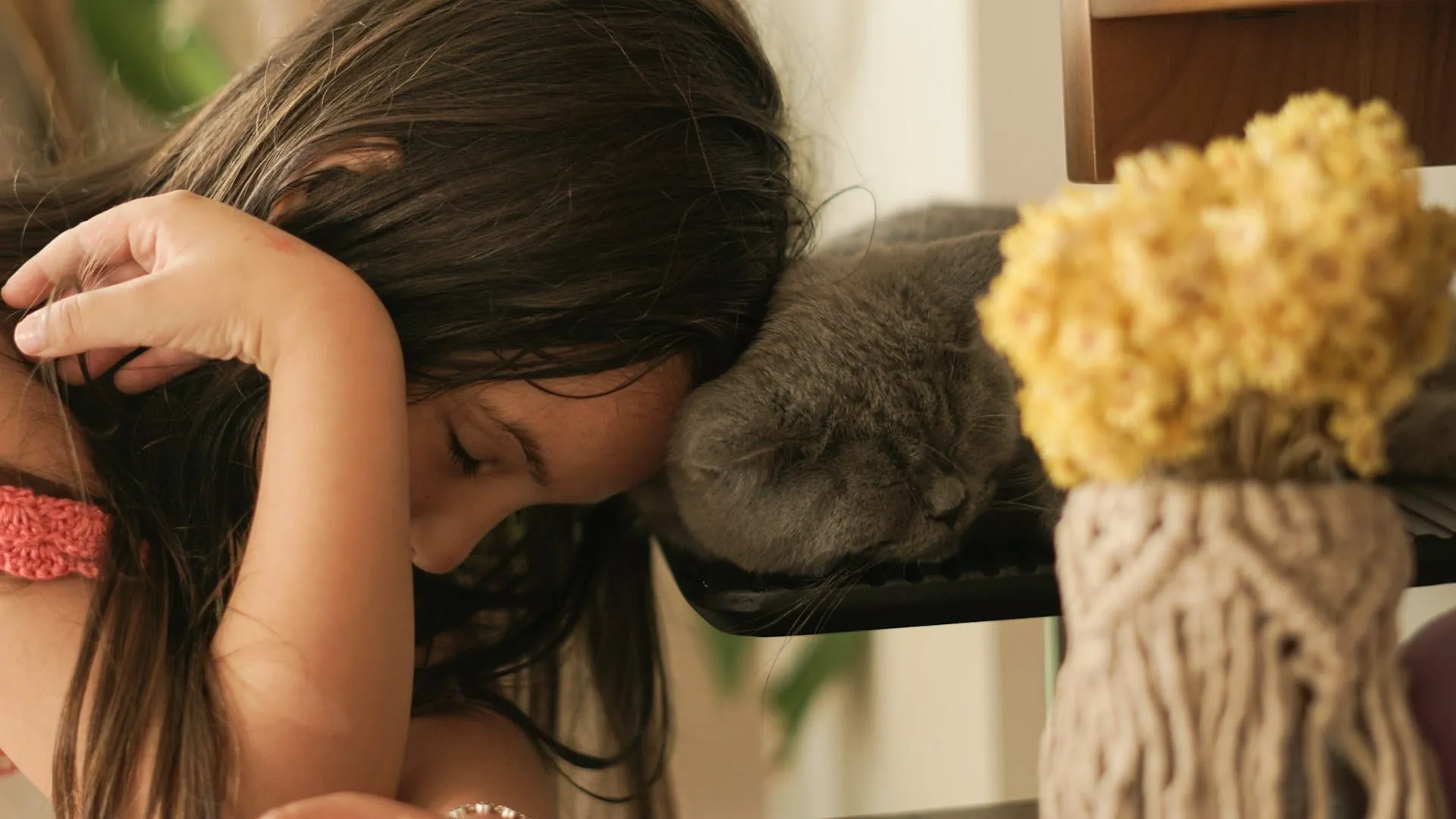
Comforting children after a pet’s death is mostly a matter of telling the truth in small, plain words and then staying in the room for the questions. You don’t need the perfect sentence. Children take their cue from whether the adult in front of them is steady, not from whether the explanation was elegant.
This is the first death a lot of children ever meet. That makes it heavy. It also means this one tends to stay with them: what happens in your house this week shapes what they come to believe about loss, about honesty, and about whether hard things can be said out loud here.
What follows is what to say and when, how the same news lands differently at four and at fourteen, the questions children actually ask, and the signs that say a child needs more support than a parent can give alone. If your child is in immediate danger or has already hurt themselves, call 911 now. If they’ve said anything about hurting themselves or about not wanting to be alive, or you think they might be thinking about suicide, call or text 988, then come back to this when you can.
Key Takeaways
- Use the word “died.” Nemours KidsHealth cautions against sleep language when a pet is euthanized, because young children take things literally and it points them somewhere frightening.
- Children grasp death in pieces rather than all at once, and a 2026 review suggests those pieces come from a child’s experiences as well as from cognitive development.
- Expect the same questions repeatedly and grief that arrives in short bursts. A child crying one minute and asking for a snack the next isn’t being callous; that’s the shape children’s grief takes.
- Give your child real choices about their part in the goodbye and the memorial, and take no for an answer. The Dougy Center notes that choices help re-establish a sense of power, control, and trust.
- If your child is in immediate danger, call 911. Otherwise call or text 988 if they’ve said anything about hurting themselves or about not wanting to be alive, and the AAP’s instruction is to call right away if you think your child may be thinking about suicide, even without saying so. It’s free and confidential, and in the US it takes calls about a child from the adult who loves them.
Table of Contents
- 1What to Say When You Tell a Child Their Pet Died
- 2How Children Understand a Pet’s Death at Different Ages
- 3A Child’s Grief Doesn’t Look Like Yours
- 4The Questions Children Ask, and How to Answer Them
- 5Explaining Euthanasia, and Whether to Include Your Child
- 6Memorials Children Can Actually Take Part In
- 7What Not to Say to a Grieving Child
- 8When to Get Help for a Grieving Child, and When to Call 988
- 9Grieving While You’re the Steady One
- 10Comforting Children After a Pet’s Death Shapes What Comes Later
- 11Frequently Asked Questions About Comforting Children After a Pet’s Death
What to Say When You Tell a Child Their Pet Died
Tell your child in a quiet place, using the word “died” in the first sentence. Say what happened in one or two plain lines, stop talking, and let them react however they react. The Dougy Center, whose guidance is written for the death of a person and transfers cleanly, says there’s no magical right time to share the news; the right time is the one you create.
For a young child, that can be as short as: “I have sad news. Rosie died this morning. Her body stopped working, and it can’t start again. She isn’t in any pain.”
If your pet was euthanized, an older child can take more of the actual story, because children often fill a gap with something worse than the truth: “Rosie’s kidneys were failing, and the medicine stopped helping. The vet said she was suffering and wouldn’t get better. She died at the clinic this afternoon, and I was with her.”
Then stop. The silence after isn’t a failure of the conversation. For many children, it’s where they assemble the questions, and some need days for that.
Why the Word “Died” Matters More Than It Seems
The strongest reason to avoid soft language isn’t abstract honesty. It’s that young children process words literally, and the most popular euphemism attaches death to something a child has to do every night. Nemours KidsHealth, writing about euthanasia, cautions against saying the animal went “to sleep” or “got put to sleep,” because young kids can take things literally, and it can conjure up scary ideas about sleep or surgery and anesthesia.
Vanishing language fails the same way. “We lost her” invites a search, and “she went away” invites waiting by the door. Say died, and say it more than once if you need to. Repeating it plainly isn’t cruelty. It’s what lets a child stop guessing.
Honesty and gentleness aren’t in tension here. Jeannine Moga, a licensed clinical social worker who then directed the Family and Community Services program at NC State’s Veterinary Health Complex, told the college in 2014 that conversations should be age-appropriate, but that even the youngest child should get honest information about what death is and what it looks like.
How Children Understand a Pet’s Death at Different Ages
Children assemble the idea of death in pieces rather than receiving it whole, and the pieces arrive over years. A 2026 review in Clinical Child Psychology and Psychiatry identifies three widely agreed components, biological cessation, irreversibility, and universality, plus several less firmly established ones including causality, and reports that irreversibility is usually learned first, as early as age three, while causation is usually learned last, sometimes by age eight.
The ages are ranges, not a timetable, and your child may sit somewhere else entirely. The more useful point is that the same review notes that children build their understanding of death through experience, not cognitive development alone. This loss is one of those experiences.
Toddlers and Preschoolers
Expect the question to come back. The American Academy of Pediatrics notes that toddlers might ask over and over where the pet is, and may even seem unconcerned by the death, and younger preschoolers, like toddlers, can have difficulty with the concept of death.
Seeming unbothered isn’t the same as being unbothered, and on its own it says very little about how well the explanation landed. Keep the answer identical each time it’s asked. Parents often describe the repetition as a child checking whether the answer holds, and a consistent answer is the one thing you can reliably offer.
School-Age Children
By this age, most children can hold the idea properly, and the AAP notes that kids at this age are much more able to understand death. What often shows up instead is the search for a cause, and children are entirely capable of nominating themselves as one. Watch for the sideways version of that question, which rarely arrives as “was it my fault” and often arrives as “what would have happened if I’d checked on her.”
It’s also when the questions about mechanics arrive. Where is her body now? Does it hurt to be dead? What happens at a crematory? Answer plainly; the details are less frightening than the blank.
Teenagers
The AAP notes that most teenagers can understand abstract concepts like death, so the difficulty is rarely comprehension. It’s that a teenager may not want to be seen grieving, particularly over an animal, and particularly by you.
Give them the information an adult would get and then give them room. An open invitation, repeated a few days later without pressure, often works better than a scheduled conversation. If they had a job caring for the pet, ask what they want to happen to that job now, instead of quietly taking it over yourself.
Comforting Children After a Pet’s Death Isn’t Age-Scripted
Use these as a starting point, not a diagnosis. KidsHealth’s advice is to base how much children hear on their age, maturity level, and life experience, and a child who has already had a grandparent die, or who has a developmental difference, may sit nowhere near their age band. Our guide to helping a child with special needs through pet loss goes further.
A Child’s Grief Doesn’t Look Like Yours
Children’s grief comes in short bursts rather than one unbroken stretch, which is why the crying can stop as abruptly as it started. Moga describes very young children as unable to hold attention on one topic, processing emotions in bursts, and advises parents to stay available for more conversations.
That pattern gets misread constantly. A child dipping in and out isn’t being shallow. They’re not “over it,” and they’re not performing. They’re taking grief in doses they can carry.
The Behavior That Doesn’t Look Like Grief
Some of it won’t present as sadness at all. Depending on the child, it can look like a return to habits they’d outgrown, sleep that goes sideways, a shorter fuse, stomach aches with no cause the doctor can find, clinginess at drop-off, or a sudden flatness about things they used to like. Teenagers may go quiet and spend more time out of the house.
Any one of these on its own is usually ordinary grief rather than a sign something is wrong, and no source will hand you a schedule for it. The AAP is explicit that pediatricians don’t have a set timeframe for how long a child’s grief takes, and that some children take longer to move through it than others. What matters is direction, not speed. “Signs Your Child May Need a Grief Professional” below covers the point where nothing is moving at all.
No Timeline Exists, and Saying So Helps
Children ask how long this lasts, and so do parents. The honest answer is that nobody can give you a number. The Dougy Center puts it plainly: grief doesn’t have a timeline, and it changes over the course of someone’s life. They also point out that there’s no right or wrong way to grieve, and that each experience is unique.
Say that out loud to your child. Many of them assume there’s a correct way to do this and quietly worry they’re doing it wrong.
The Questions Children Ask, and How to Answer Them
Most children ask a version of the same handful of questions, and having a sentence ready means you’re not composing one while they watch your face. Answer the question asked rather than the one you’re dreading, and stop when it’s answered.
“Was it my fault?”
This one comes up more than parents expect, often attached to something tiny: a gate, a walk that got skipped, a day they were annoyed with the animal. Answer directly and without a speech. If nothing they did contributed, say so plainly: “No. Nothing you did or forgot caused this.” If something they did was part of the chain, don’t build a denial you’ll have to walk back later; “You didn’t mean for this to happen, and you didn’t know. I’m not angry at you” is true, and it holds. Either way, name the actual cause in plain terms.
Resist the urge to over-argue it. A long defense can sound to a child like there was something to defend. If the blame lands on you instead, our guide to what to do when your child blames you for the pet’s death is written for that conversation.
“Are you going to die? Am I?”
Many children arrive here because a pet dying is often the first evidence that the rule applies generally. Don’t promise what you can’t. Something like “Yes. Everyone dies someday. Most people live a long, long time first. I’m not planning on going anywhere, and there are a lot of grown-ups who love you and would look after you no matter what” is honest without handing a four-year-old a probability.
“Where is she now?”
Two different questions live inside this one, and the first job is working out which you’re being asked. If it’s about the body, answer factually: at the vet’s, at the crematory, buried in the yard. If it’s the larger question, you’re allowed to answer from your family’s beliefs, and you’re allowed to say that people believe different things and you find one of them comforting. Saying “I don’t know for certain, and here’s what I believe” isn’t evasion. What lands as evasion is a parent who won’t answer at all.
“Can we get another one?”
Sometimes asked ten minutes after the news, which can land badly on a grieving adult. It’s usually not a request to replace anyone; at younger ages it’s closer to asking whether the good thing is gone forever. If you’re not ready, you can say so honestly, and say that you don’t know when you will be. The AAP’s guidance is to explain a new pet as a different adventure rather than a way to cope.
Explaining Euthanasia, and Whether to Include Your Child
When a pet has been euthanized, explain it in terms of what was happening to the animal’s body and what the medicine actually did. KidsHealth takes a position with two halves that are easy to mistake for a contradiction. It cautions against saying the animal went “to sleep” or “got put to sleep.” It also says that if your child’s age, maturity, and questions call for a clear explanation of what will happen, it’s fine to say the veterinarian gives a shot that first puts the pet to sleep and then stops the heart from beating.
The practical read, and this part is our judgment rather than theirs, is that sleep named as one step inside a described procedure lands differently from “we put her to sleep” offered as the whole story. If you’re explaining after the fact rather than before, the same applies: describe what the medicine did, in order, rather than reaching for the shorthand.
This guide won’t tell you whether the decision or its timing was right. Nobody who wasn’t in that room can, and a page on the internet least of all. What it can say is our own position: a difficult fact plainly told tends to hold up better than a comfortable story a child later discovers was wrong. Our guide to preparing for a pet’s euthanasia sits with the adult side of it.
Whether to Bring Them
There’s no single right answer, and it depends more on the child than on age. Moga separates the decisions: some children might not want to be present at the time of death but may still want to say goodbye to the animal’s body afterward, before burial. She notes the veterinarian can help arrange it so the children can say goodbye without it being traumatic. KidsHealth adds that many kids want a chance to say goodbye first, before the procedure.
So there are three offers, not two, and you should make them separately. Before anyone decides, ask your vet to walk you through exactly what will happen and what it will look like. If your child wants that too, ask for it. Then ask all three. Would you like to say goodbye beforehand? Would you like to be in the room? Would you like to see them afterward? Children need to know in advance about the things that startle adults too: that the eyes often stay open, that there can be a last breath or a twitch afterward, that the body will feel different. Then take whichever answers you get, including a changed mind at the clinic door.
If It Already Happened Without Them
Plenty of families never get the choice, and plenty made a call in the moment that a child later wishes had gone differently. If your child is upset they weren’t there, let them be upset without talking them out of it, tell them why the decision was made the way it was, and offer them something they can still do now. A letter, a drawing left at the grave or tucked in with the ashes, or a goodbye said out loud at home aren’t consolation prizes; they’re the same act, later.
Memorials Children Can Actually Take Part In
A memorial gives a child something to do with feelings they can’t yet put into words, which is most of why it helps. The AAP suggests a small memorial or ritual such as scattering ashes, making a memorial collage, or planting a tree, while noting that a child might find it uncomfortable, so suggest it gently and follow their wishes.
That last clause matters. An invitation your child can decline is a memorial; a ceremony they’re marched into is an errand.
Ideas that tend to work, roughly youngest to oldest: drawing a picture of the pet to keep or bury, choosing which photo gets framed, filling a memory box with the collar and a favorite toy, writing a letter and reading it aloud or not reading it aloud, saying one thing each at a small ceremony, picking the spot for a tree planted in the pet’s memory, or taking charge of a photo book. Older children and teens can handle real decisions, including choosing an urn or helping plan whatever you’re doing to mark it.
Let them choose wherever you can. The Dougy Center makes the case that offering choices helps give back some of the control a death takes from a child. Our roundups offer more options for healing rituals to honor a pet and ways to preserve a pet’s memory.
What Not to Say to a Grieving Child
The phrases to avoid are the ones that trade clarity for comfort: sleep language, vanishing language, and anything that ranks the loss, hurries it along, or asks your child to manage it. Most are things loving parents say while trying to make it hurt less. They’re listed here for how they land, not for what the person saying them meant.
- “She went to sleep.” The one to drop first, for the reason given under “Why the Word ‘Died’ Matters More Than It Seems.” Same for “put to sleep” as a standalone explanation.
- “We lost him.” The Dougy Center lists “lost” among the euphemisms to avoid because they confuse children, and a child who hears it can reasonably conclude the animal might be found.
- “He went away” or “went to live on a farm.” A child who believes this waits, then later realizes they were lied to at the exact moment they most needed to trust you.
- “Don’t cry” or “be strong for your sister.” Teaches that grief is a thing to hide, and often produces a child who stops telling you how they are.
- “It was just a pet.” Ranks the loss for them. Whatever this animal was to your child, that’s the size of it.
- “We’ll get another one this weekend.” Offered as comfort, heard as replaceability. Answer the question about a future pet honestly, but separate it from the goodbye.
- “You’re the man of the house now” or any version that hands a child a caretaking job. Grieving adults need support from other adults.
Already said one of these? It’s fixable. A correction usually lands fine when it comes with an apology: “I’m sorry. I said Rosie went to sleep. That wasn’t clear, and I want to tell you properly. She died.”
When to Get Help for a Grieving Child, and When to Call 988
If your child is in immediate danger or has already hurt themselves, call 911 now and stay with them until help arrives, or take them straight to your nearest emergency department. If they’ve said anything about hurting themselves or about not wanting to be alive, call or text 988. Everything else here can wait until you’ve done those two things.
That second one holds even without words. The AAP’s instruction is to call 988 right away if you think your child may be thinking about suicide, whether or not they’ve put it into words, so a suspicion you can’t quite justify is still a reason to call.
Do this now, whatever time it is, and whether or not you’ve reached anyone yet: remove or lock up firearms and medications, including over-the-counter painkillers, and anything else your child could use to hurt themselves. Don’t leave them alone while you’re arranging help.
The 988 Suicide & Crisis Lifeline states that it’s available 24/7/365 and that conversations are free and confidential. You can call, text, or chat at chat.988lifeline.org, which is often the route a teenager will actually use, and there are dedicated services in Spanish and for Deaf and hard-of-hearing callers. You can contact them about your child, not just yourself, and the AAP notes their counselors can link you with emergency services in your area. Outside the US, Find A Helpline lists verified crisis lines in over 175 countries, because 988 only routes within the States.
Once the immediate danger has passed, tell your pediatrician what’s happened, today or first thing tomorrow. The rest of this section is about a slower problem: a child who needs more support than a parent can give, over weeks and months rather than tonight.
Signs Your Child May Need a Grief Professional
Ordinary grief is heavy and gets gradually lighter. What warrants a professional is grief that isn’t moving, or that’s taking the child’s functioning with it. The AAP lists four signs, and notes that needing this level of help isn’t common: persistent difficulty with daily functioning at home or school months after the pet’s death; preoccupation with thinking about the deceased pet; substance use or other acting-out behaviors; and deep, prolonged sadness or depression. To that fourth sign they attach suicidal behavior and a separate instruction: call 988 right away. That one isn’t a wait-and-watch sign. The Dougy Center’s threshold is similar, and also written for the death of a person: ongoing behaviors that interfere with a child’s daily life.
In practice, that’s school refusal or a slide that isn’t recovering, sleep or eating changes that persist, withdrawal from friends and things they loved, aggression that keeps escalating, or a child stuck on the death to the exclusion of everything else. Ask the school what they’re seeing; they have a comparison you don’t.
Who to Call
Start with your pediatrician, who can screen and refer, and who already knows your child. A child or adolescent therapist is the next step, and it’s reasonable to ask specifically whether they work with grief and loss in children. Some families find a school counselor is the fastest door, often quicker than an outside referral.
For pet loss specifically, our directory of pet loss grief counselors lists people who treat the death of an animal as a real bereavement, and our guides to what pet loss grief counseling involves and free pet loss hotlines cover what’s available. Wanting help early isn’t an overreaction, and waitlists being what they are, early often turns out to be about right.
Grieving While You’re the Steady One
You’re grieving this animal too, and doing it while being the person your child checks for reassurance. Something has to give, and for most parents what gives is their own grief, postponed to some quieter week that doesn’t arrive.
Your own grief isn’t a side issue here. The Dougy Center’s last tip is to find sources of support for yourself, because how well a child does after a death is linked to how well the adults in their lives are doing. Looking after your own grief is part of the job, not a break from it.
Practically: let your child see you sad without letting them manage it. “I’m crying because I miss her. It’s not your job to fix it, and I’m okay” shows a child what grieving looks like when it’s safe, which a composed face can’t. If there’s another adult in your life for this, take the harder crying to them; if there isn’t, use a pet loss line or a counselor. Our guide to how pet loss changes family dynamics covers where that support comes from.
Comforting Children After a Pet’s Death Shapes What Comes Later
Comforting children after a pet’s death isn’t only about this week. This is very often a child’s first real encounter with death, and what they take from it is less about the animal than about what happened in the house afterward.
What they learn is whether hard truths get told plainly here, whether their questions are welcome even the fourth time, whether crying gets met or managed, and whether the adults they love can be sad and still be steady. That’s a set of expectations about loss they will carry into losses much larger than this one.
You will get pieces of it wrong. Children aren’t grading the sentences. They’re watching whether you stayed. The rest of our writing on family relationships and pet loss is here when you want it.
And when they ask about the pet in six months, out of nowhere, in the car, the answer is still the simple one: tell them a story about her. That’s the part they’re actually asking for.
Frequently Asked Questions About Comforting Children After a Pet’s Death
What should I tell my child’s school or teacher?
Send a short message the same day or the next morning, before your child walks in. Two or three lines is plenty: the pet died, when it happened, and how your child seems to be taking it so far. Teachers watch your child next to twenty others every day, which is a vantage point no parent has, and it only helps if they know to use it. Ask them to tell you if they see withdrawal, trouble focusing, tears at odd moments, or friction with other kids, and let them know whether your child would rather it not be mentioned in front of the class. That last part matters more with older children, who often dread being the subject of sympathetic attention. Also ask whether the school has a counselor your child could see without it becoming a whole production, because a familiar adult already in the building costs nothing and can usually be arranged in days rather than weeks. If siblings attend the same school, tell both teachers, since children in the same family often grieve on completely different schedules.
My child doesn’t seem upset at all. Should I be worried?
Usually not, and it’s one of the most common worries parents have. Young children in particular can hear the news, ask one question, and go straight back to playing, and the American Academy of Pediatrics notes that toddlers may even seem unconcerned by a pet’s death. That isn’t coldness or a failure to understand; children process in short bursts and often need time to come back to it. Older children sometimes hold it in deliberately, either because they’ve read the room and decided you have enough to carry, or because crying in front of a parent feels like too much exposure. What’s worth doing is leaving doors open rather than prying: mention the pet yourself now and then, keep a photo where they’ll see it, and let them know sadness is allowed here whenever it turns up. Watch the quiet indicators instead of the obvious ones, like sleep, appetite, and whether they still want their friends. If weeks pass with no reaction at all and something about it feels off to you, that’s worth raising with your pediatrician, less because silence is dangerous and more because you know your child, and that instinct is worth listening to.
How do I tell children of different ages at the same time?
Tell them together first, in the simplest language the youngest one needs, then follow up with each child separately. The shared moment matters because it means nobody learns it secondhand from a sibling, and because it makes clear this is a family thing, not a secret. Keep the group version short and factual, because a five-year-old’s version of the news is the version everyone can follow. Then go to the older ones individually within a day and give them the fuller account, including the medical details or the reasoning behind a decision, which they will otherwise assemble from overheard fragments. Expect the responses to be wildly different in the same room, and try not to let one child’s reaction become the standard the others get measured against out loud. Older siblings sometimes appoint themselves comforter to the younger ones, which can look like coping and can be a way of skipping their own grief entirely, so it’s worth telling them directly that this isn’t their job. Circle back to each child separately a few days later, because the questions rarely arrive that day.
What do I say when my child tells someone and gets a dismissive reaction?
Name what happened rather than smoothing it over, because your child already noticed. Something like “That was a lousy thing for her to say, and it doesn’t change anything about how sad you are” does the job. Adults say “it was only a dog” or “you can always get another” mostly out of discomfort rather than malice, and it can help an older child to know that people say clumsy things when they don’t know what to do with someone else’s sadness. What you’re protecting is your child’s sense that their grief was reasonable, so the correction should land on the comment rather than on the person, especially if it came from a relative they’ll see again. It also helps to give your child a short exit line for next time, something like “yeah, I really miss him” that ends the exchange without requiring them to defend anything. Let them decide who they tell from then on; a child who chooses to stop mentioning it at school usually isn’t repression so much as managing their audience, which is a reasonable adult skill. Make sure at least one person in their life reliably gets it right, whether that’s you, a grandparent, or a friend who also loved the animal.
We still have another pet at home. How do I handle that with my child?
Tell your child plainly that the surviving animal may act differently for a while, so the change doesn’t arrive as a second frightening mystery. Surviving pets sometimes change their behavior after a death, and a child who sees the dog searching the house or going off their food will draw conclusions if nobody explains it. Give them a real job in the surviving pet’s care if they want one, since many children find having a job steadying. Watch for two opposite patterns worth gently interrupting: a child who becomes frantically vigilant about the remaining pet, checking on them constantly and getting upset by small things, and a child who pulls away entirely because loving something feels too dangerous right now. Both often ease as the weeks pass, and both respond better to being named kindly than to being corrected. Keep the surviving animal’s routine as intact as you can, which helps the pet and gives your child one part of the house that still runs normally. If your child starts asking anxious questions about whether this one will die too, answer honestly and briefly rather than promising, then turn it toward what you actually do to look after them.
On this topic