







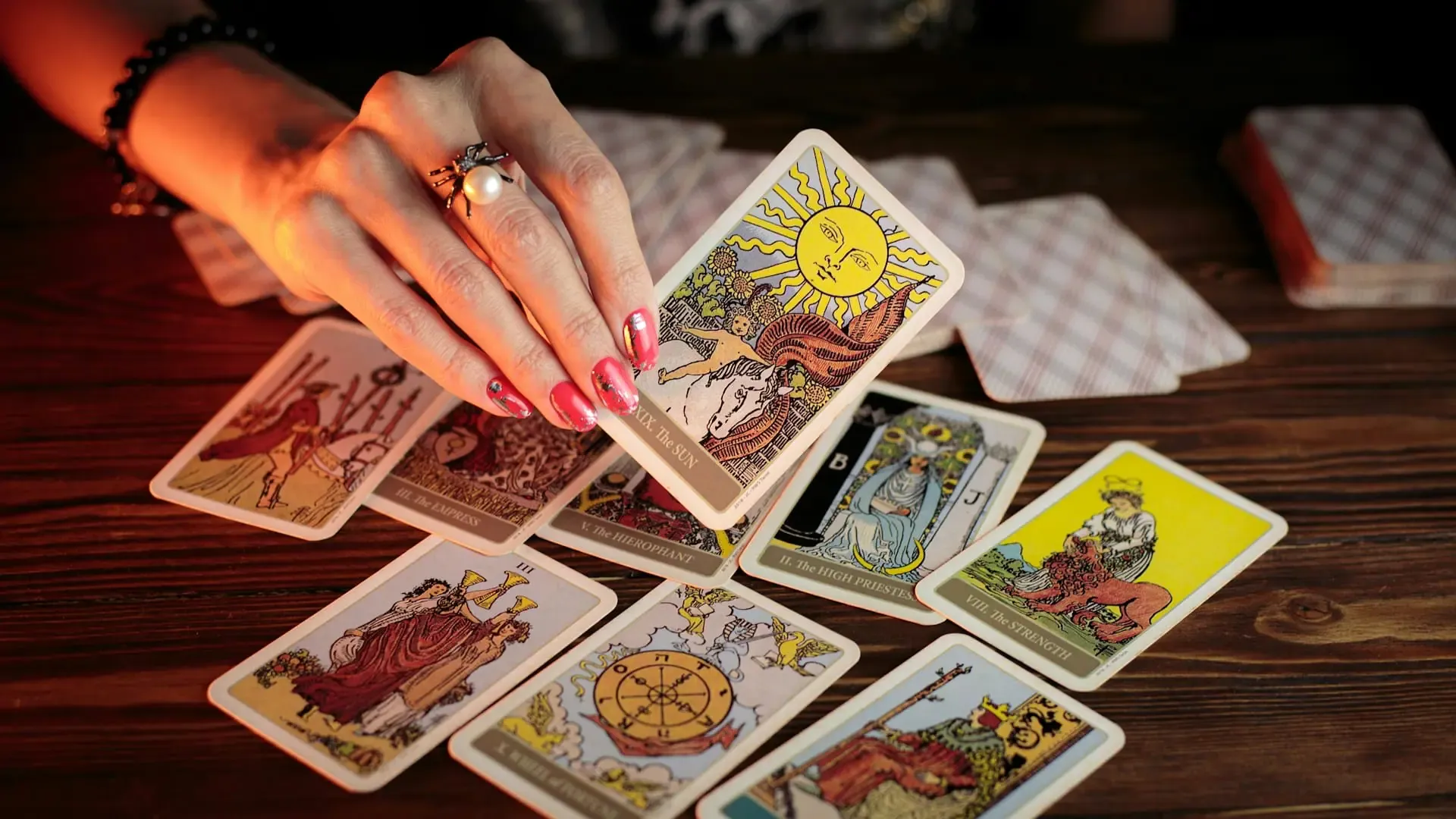
Not everyone reaches for tarot after losing a pet. Some people never would. But some people do, and they often don’t talk about it much, because they’re not sure how it will land. This post is for them, and for anyone who’s curious but hasn’t tried it yet.
Tarot and other divination practices aren’t grief therapy. They’re not a cure, and we’re not presenting them as one. For some people, it can be a quiet space for reflection. A ritual. A way of sitting with your feelings long enough to understand them a little better. And after losing a pet, that kind of space can be genuinely hard to find.
We see this question come up often in the pet loss community: people who already use tarot or oracle cards for reflection, wanting to know how others have used them after losing a pet. We also hear from people who have never touched a deck but are looking for a symbolic or spiritual container for their grief, something that feels more personal than just talking it through. Using tarot after pet loss isn’t for everyone. But for the people it’s for, there’s something real here worth taking seriously.
This post doesn’t push you toward anything. It explains what these practices actually are, how some grieving people use them, and gives you something concrete to try if you want to. Take what fits. Leave the rest.
Key Takeaways
- Tarot after pet loss is a reflective and ritual practice, not a predictive tool. The value is in what it surfaces about your own feelings, not in any claim about what the cards can know.
- Research published in PMC documents that ritual behavior, including symbolic practices, can reduce grief intensity and restore a sense of agency after loss, which may help explain why some grieving people find divination meaningful.
- The Death card in tarot does not represent literal death. In a grief reading, it typically speaks to transition, change, and the ongoing movement between what was and what comes next.
- Oracle cards lack a standardized structure, making them more accessible to people new to divination or those who want something simpler and more intuitive.
- Divination practices don’t replace grief support. If you’re struggling, connecting with a pet loss grief counselor or a peer support community alongside any spiritual practice is a meaningful step.
Table of Contents
- 1Why Some Grieving People Turn to Divination
- 2Tarot as a Grief Processing Tool
- 3Tarot Cards That Speak to Pet Loss and Grief
- 4A Simple Three-Card Spread for Pet Loss
- 5Oracle Cards: A Gentler Entry Point
- 6Other Divination Practices Some Grieving People Use
- 7What to Do If a Reading Stirs Up Difficult Feelings
- 8Combining Spiritual Practice With Other Grief Support
- 9Finding Your Own Way Through Grief
- 10Frequently Asked Questions About Tarot and Divination After Pet Loss
Why Some Grieving People Turn to Divination
After losing a pet, the first few days can feel completely unanchored. The routines are gone. The house is too quiet. And most of the usual ways people process hard things, talking to friends, working through a problem logically, just waiting for time to pass, don’t quite touch the particular texture of this grief.
Divination practices, including tarot, runes, and oracle cards, offer something different. Not answers. Not a map of what comes next. What they offer is a structured moment of reflection, a ritual that slows you down and asks you to pay attention to what you’re actually feeling. That alone is worth something when grief makes everything feel blurry.
Research published in PMC on ritual and grief processing documents that ritual behavior can reduce grief intensity and restore a sense of personal agency after loss. The act of following a structured symbolic practice, even a simple one, appears to help the grieving mind regain some sense of footing. Tarot, at its most basic, is exactly that: a structured symbolic practice.
People also turn to divination because it can feel like a form of connection. When a pet is gone, the relationship doesn’t vanish instantly. The love is still there, looking for somewhere to go. Some grieving people use tarot not to predict anything, but to create a quiet space where they can sit with that love and let it exist without having to do anything with it. That’s not mysticism. That’s grief.
The grief counselors and end-of-life specialists we work with often note that grieving people benefit from ritual precisely because it provides a container. Something with a beginning, a middle, and an end. Tarot readings have that structure built in. Whether or not you hold any particular belief about how cards work, the practice of pulling them, sitting with them, and reflecting on what they bring up gives grief a shape it doesn’t otherwise have.
Tarot as a Grief Processing Tool
Tarot cards originated in 15th-century Europe as playing cards. They were adopted for divination over time and came to be associated with symbolic and spiritual interpretation across many traditions. A standard tarot deck has 78 cards: 22 Major Arcana cards representing larger life themes and forces, and 56 Minor Arcana cards covering everyday experiences, emotions, and relationships.
As a grief processing tool, tarot works through reflection, not revelation. You’re not asking the cards to tell you something they couldn’t possibly know. You’re using them as a prompt. Each card carries an image and a set of associated themes. When you pull a card and sit with it, you’re really asking yourself: what does this mean to me, right now, in this grief?
That’s a more honest framing than “the cards have the answer.” The card is a mirror. What you see in it is yours. And sometimes what you see surprises you, because grief has a way of burying feelings you didn’t know were there, and a symbolic prompt can help them surface.
This is especially true for people who struggle to access their emotions verbally. Some grieving pet parents can’t easily answer the question “How are you feeling?” But show them a card depicting a figure resting alone in a quiet room, and they might immediately recognize something about their own experience. That’s the mechanism. The image does the work of opening a door that the direct question couldn’t.
You don’t have to have any particular spiritual belief to use tarot this way. Some people who use it regularly are deeply spiritual. Others are completely secular and treat it as a form of structured journaling with pictures. Both approaches are valid. The tool itself is neutral. What you bring to it determines what you get out of it.
If you want to explore spirituality and grief more broadly, Love, Baxter’s spirituality and beliefs resources cover a range of approaches to this part of the experience.
Tarot Cards That Speak to Pet Loss and Grief
Certain cards in the tarot appear again and again when people are working through grief, not because the deck is programmed for it, but because the imagery and themes of those cards resonate deeply with what grief actually feels like. If you’re doing readings while processing the loss of a pet, you may find these cards coming up often. Here’s what they typically represent in a grief context.
The Death Card
This is the one most people fear pulling, and it almost always means something other than what they expect. In standard tarot interpretation, the Death card represents transition and transformation, not literal death. When it appears in a grief reading, it’s usually pointing toward the movement between what was and what is becoming. Your life with your pet was one chapter. This card often speaks to the threshold you’re crossing, and what might grow on the other side.
The Star
The Star card represents hope after difficulty. It doesn’t minimize the hard thing that happened. It appears after storms, and it says, “Something is still here.” In a grief reading, many people pull this card when they’re starting to feel the first small stirrings of something other than pain, not an erasure of grief, but a coexistence with it. If you pull this card while still in acute grief, it doesn’t mean you’re supposed to feel hopeful yet. It may just be pointing toward what’s possible eventually.
The Moon
The Moon is associated with the unconscious mind, with grief, confusion, and things that live below the surface. Pulling this card often signals that there’s more happening emotionally than is fully visible to you right now. It’s a card of patience with yourself. It acknowledges that not everything in grief can be seen clearly, and that’s okay. You’re in the dark part of the process. The Moon doesn’t ask you to make sense of it. It just asks you to stay.
Four of Swords
Rest, recovery, and contemplation. The Four of Swords is one of the most directly applicable cards to acute grief. The imagery typically shows a figure lying in repose, at rest, taking time away from the world. This card often appears when someone needs permission to stop pushing through and simply be still. In a pet loss reading, it can be a quiet signal that the most useful thing right now isn’t doing anything at all.
Ace of Cups
The Ace of Cups represents emotional new beginnings and the capacity for love. This card doesn’t always appear in early grief. But when it does, it may be speaking to the love that is still present, the love that your pet generated in you that doesn’t disappear with them. Some people interpret this card as the grief itself, because love at that intensity is what grief is made of.
Six of Swords
This card speaks to transition while still carrying the weight of what came before. The traditional image shows a figure being ferried across water, away from something difficult and toward something else, but the swords in the boat remain. They haven’t been dropped. This is a very honest representation of how grief actually moves: you don’t leave it behind, you carry it forward. The Six of Swords acknowledges that truth without demanding that you be further along than you are.
A Simple Three-Card Spread for Pet Loss
If you want to try tarot as a reflective practice after losing a pet, this spread is a good starting point. It’s simple, focused, and specific to what you’re navigating right now. You don’t need to know anything about tarot beyond what’s described here.
Shuffle the deck in whatever way feels natural. Some people shuffle slowly and think of their pet as they do so. Others shuffle until they feel ready to stop. There’s no wrong way. When you’re ready, pull three cards and lay them face down, left to right. Then turn them over one at a time.
Here’s what each position represents:
- Card 1: What I’m carrying right now. This card reflects the emotional weight you’re holding in this moment. Don’t look for a literal match. Look for what the image brings up when you sit with it. If it stirs something, follow that feeling.
- Card 2: What my pet meant to me. This position invites you to think about the relationship itself, what this animal gave you, what you gave them, and what the bond felt like at its core. The card isn’t defining that; you are. The card is just the prompt.
- Card 3: What I need to move through this. Not forward, through. This card is about what might support you right now. It might point toward rest, connection, patience, or grief expressed rather than held. Whatever comes up, sit with it for a moment before you dismiss it.
After the reading, you might write a few sentences about what came up. You don’t have to. But many people find that putting words to their reflections helps them settle. Some people pull these three cards every few days while in active grief, not to get different answers, but because what comes up changes as the grief moves.
There’s no pressure to interpret the cards “correctly.” There is no correct. What matters is what you felt.
Oracle Cards: A Gentler Entry Point
Oracle cards differ from tarot in one significant way: they have no standardized structure. A tarot deck always has 78 cards organized into specific suits, each with meanings that have developed over centuries. Oracle decks are whatever the creator made them. The card count, the imagery, the meaning system, all of it is defined by the person who designed the deck. Some decks have 44 cards; some have 60. Some focus on animals, some on nature, some on grief specifically.
For someone new to divination, that lack of standardization is actually an advantage. You’re not learning a system. You read the card in front of you, look at the image, read the description in the accompanying guidebook, and ask yourself what it stirs in you. That’s the whole practice.
Several oracle decks have become particularly popular in grief and pet loss communities. The Sacred Forest Oracle by Anna Blackwell uses nature imagery that many pet parents find resonant. The Animal Spirit Oracle by Kim Krans offers animal-based symbolism that can feel particularly meaningful when grieving a pet. The Grief Oracle by Emily Francis is designed specifically around loss and is often recommended for people going through exactly this kind of experience. These are examples; many others exist, and the deck that feels right for you is more important than any recommendation.
Oracle cards can be used the same way as tarot, with single-card daily pulls or multi-card spreads. But because the meanings are simpler and the system is less complex, they tend to require less learning time and produce more immediate reflection. If tarot feels like too much of a commitment right now, oracle cards are a reasonable place to start.
Other Divination Practices Some Grieving People Use
Tarot and oracle cards are the most common, but they’re not the only divination practices people turn to in grief. A few others come up consistently in our community.
Runes
Runes are an ancient Germanic alphabet system used in Northern European traditions, later adopted as a divinatory practice. A standard runic set has 24 stones or tiles, each marked with a symbol that carries associated meanings: protection, journey, transformation, rest, and so on. Drawing a single rune each day as a reflective prompt is a common practice. The symbolism tends to be direct and elemental, and many grieving people find the physical act of reaching into a bag and drawing a stone more grounding than working with cards.
Pendulums
A pendulum is a weighted object on a string, used by holding it still and observing the direction of its swing in response to questions. Pendulum work is typically used for yes/no inquiries and is considered an intuitive practice by its practitioners. Some grieving people use pendulums not to get specific answers, but to check in with themselves: “Am I ready to look at their photos today?” or “Do I need to reach out to someone?” The practice helps you slow down and actually listen to your own response to a question you might otherwise rush past.
Scrying
Scrying involves gazing into a reflective or translucent surface, traditionally a crystal ball or a dark mirror, and allowing the mind to quiet into a meditative state. It’s a deeply personal practice with roots across many cultures. People who use scrying often describe it as less about seeing visions and more about reaching a state of quiet in which feelings and thoughts can surface without pressure. After the constant activity of grief, some people find this kind of enforced stillness genuinely useful.
None of these practices is a prescription. Some will feel right to you, and some won’t. Try what draws you and set aside what doesn’t. If you’re interested in other ways to honor your pet that don’t center on any religious tradition, our post on meaningful ways to honor a pet without religion covers a range of approaches.
What to Do If a Reading Stirs Up Difficult Feelings
This is worth addressing directly. Tarot and other reflective practices can surface things that were sitting just below the surface of your awareness. That’s partly the point. But sometimes what surfaces is harder than expected: guilt that was dormant, anger you didn’t know was there, a depth of grief that catches you off guard.
If a reading brings up something intense, that’s not a failing of the practice. That’s the practice working, possibly more powerfully than you were ready for in that moment. Here’s what to do.
Stop the reading if you need to. You’re not committed to finishing. Set the cards down and give yourself time and space before you continue.
Write about what came up. Not an interpretation, just what you felt. “This card made me think about the last day, and I realized I’m still angry that I didn’t stay the whole time.” Getting it outside of your head and onto paper gives it a form that’s easier to look at.
Reach out. If what surfaced is more than you can sit with alone, talk to someone. A friend who understands pet loss, a support group, or a grief counselor. You don’t have to process everything by yourself, and if a divination practice opens a door to something heavier than self-reflection can hold, that’s exactly when additional support becomes important.
People who connect with animal communicators and mediums sometimes describe similar experiences: something unexpected surfaces, and it needs more space than the session provides. The same is true here. Opening up to your grief, through whatever door you choose, can take you to places you didn’t expect. That’s not a sign to stop. It may be a sign to get more support alongside the practice.
We also have resources specifically for navigating the emotions of pet loss, including those that feel hardest to acknowledge. You’re not alone in what comes up.
Combining Spiritual Practice With Other Grief Support
Tarot and divination are not a replacement for grief support. We want to be clear about that. If you’re in acute grief, barely functional, struggling to sleep or eat, a daily card pull isn’t going to be enough. And there’s no version of this where we’d suggest that symbolic practices should stand in for the support a grieving person actually needs.
What they can do is exist alongside other support. Some people use morning tarot pulls and also see a grief counselor every two weeks. Some people journal with oracle cards and also attend a pet loss support group. Some people keep a daily rune draw as part of a broader spiritual practice that also includes meditation, prayer, or other rituals predating the loss.
The grief stages after pet loss are well documented, and they don’t progress in a straight line. Spiritual practices can help with the parts of grief that don’t respond to logic or information: the formless sadness, the wordless missing, the nights when nothing helps. But for the guilt, the complicated feelings, the relationship strain, the functional impairment, professional support matters. Our directory of pet loss grief counselors includes specialists who work specifically with this kind of loss.
Reading about how others have navigated the stages of grief after pet loss can also help you hold a longer perspective when any one day feels unbearable. And if you’re somewhere in the middle of grief, not in the acute early days but still carrying it, our post on why grieving a pet is completely normal may be worth reading alongside whatever else you’re doing.
Some people also find that combining divination with more direct approaches to spiritual connection feels right. If you’re drawn to the idea of connecting with your pet in ways beyond the physical, the Rainbow Bridge can be a source of spiritual comfort for many pet parents, regardless of their belief system.
Finding Your Own Way Through Grief
There’s no single right way to grieve a pet. That’s one thing we say at Love, Baxter, and we mean it completely. The people who reach out to us span every possible background, belief system, spiritual orientation, and approach to loss. What we consistently see is that the practice that helps is the one that fits the person, not the one that’s supposed to.
For some, tarot after pet loss is a genuine support. It gives the grief somewhere to go. It creates a ritual around the missing. It surfaces what needs to be felt. For others, it’s not the right tool, and that’s fine. Grief finds its own containers.
If you try a card spread and it doesn’t move you, you haven’t done anything wrong. If you try it and it opens something unexpected, you’re allowed to feel that fully. The practice is yours. The meaning is yours. What matters is that you find something that helps you stay with your grief rather than run from it, because grief is love, and love is worth sitting with.
If you want to explore more of what we’ve written on spirituality, belief, and the ways people find meaning after losing a pet, our full collection of spirituality and belief resources is available. And if you need support that goes beyond what any practice can provide, we’re here for that too.
Frequently Asked Questions About Tarot and Divination After Pet Loss
Can tarot actually help with grief after losing a pet?
That depends entirely on the person and how they approach it. Tarot doesn’t cure grief, and it doesn’t produce information that wasn’t already inside you. What it can do is create a structured reflective space, a ritual that slows you down and gives your grief somewhere specific to land for a few minutes. Research published in PMC on ritual and grief documents that ritual behavior can reduce grief intensity and restore a sense of personal agency after loss, and tarot is, among other things, a ritual practice. For people who are already drawn to symbolic or intuitive practices, tarot often feels like a natural fit for processing something as wordless as grief over the loss of a pet. For people who are skeptical or find the whole concept uncomfortable, it’s probably not the right tool, and that’s completely okay. The question to ask isn’t “does tarot work?” but “does this kind of reflective practice feel useful to me right now?” If the answer is yes, it’s worth trying. If the answer is no, there are other ways to create structure around your grief, and none of them are better or worse in any universal sense.
What does the Death card mean if it comes up in a tarot reading after pet loss?
The Death card is probably the most misunderstood card in the tarot, especially in a grief context where the fear of what it represents is already heightened. In standard tarot interpretation, the Death card does not represent literal death. It represents transition, transformation, and the movement between chapters. When it appears in a reading during pet loss grief, it typically points to the threshold you’re crossing: the life you had with your pet and the life that is slowly becoming something else. That’s not a prediction about anything. It’s an invitation to think about what this transition means for you, what is genuinely ending, and what is, even painfully, becoming. Many tarot practitioners consider this one of the most significant and ultimately meaningful cards in the deck, not because of what it portends, but because transition is one of the most honest things the cards can reflect. Pulling it in grief doesn’t mean something bad is coming. It may simply be the card acknowledging what is already true: you are in the middle of a profound change, and the cards are meeting you there.
Do I need to believe in tarot for it to be useful?
No. Many people use tarot as a completely secular reflective practice, closer to structured journaling with visual prompts than to any spiritual or supernatural belief system. The cards work as mirrors regardless of what you believe about how or why they work. You draw a card, look at the image, sit with what the imagery brings up for you, and reflect on how it connects to your current experience. That process doesn’t require belief in anything beyond your own capacity for introspection. Plenty of people who use tarot regularly are atheists, agnostics, or practitioners of traditions that have no relationship to tarot at all. The cards’ symbolic language is rich enough to be useful regardless of the framework you bring to them. If you’re coming to it purely as a grief processing tool and have no interest in the metaphysical dimensions, that’s a completely legitimate approach. Use it however it’s useful to you, and set aside the parts that aren’t.
What’s the difference between tarot and oracle cards, and which is better for pet loss grief?
Tarot has a standardized structure: 78 cards in a fixed system that has been developed and interpreted across centuries. Learning to read tarot well takes time, though you don’t need to know everything to get value from it. Oracle cards have no standardized structure. Each deck is its own system, created by its maker, with its own imagery, number of cards, and framework of meaning. For someone new to divination, or someone in acute grief who doesn’t have the bandwidth to learn a complex system, oracle cards tend to be more immediately accessible. The meanings are simpler, the imagery is often more direct, and the guidebook that comes with the deck tells you what each card represents without requiring additional study. For people who already know tarot, the system’s depth and complexity often make it more useful for nuanced reflection. Neither is objectively better for grief over pet loss. The better one is the one that fits where you are right now. If you want to start somewhere, oracle cards are a lower barrier entry point. If you’re already a tarot reader, your existing relationship with the deck may make it a more powerful tool.
Is it appropriate to use tarot to try to connect with a pet who has passed?
This is a deeply personal question and one where we’re not going to tell you what to believe or what to do. Some people use tarot, oracle cards, or other divination practices to feel connected to a pet who has died, not to receive literal messages, but to create a ritual space where that relationship still exists and can be honored. Whether you believe that kind of connection is possible in any metaphysical way is entirely your own question to answer. What we can say is that creating space to think about your pet, to focus on who they were, what they meant, and what the relationship gave you, is genuinely valuable regardless of the belief framework behind it. If pulling cards with the intention of honoring or connecting with your pet helps you stay close to their memory and feel less alone in the grief, that is a meaningful use of the practice. For people interested in more direct approaches to spiritual connection with a pet, some also work with animal communicators, which is a separate practice you can learn more about through the resources we make available specifically for that.
On this topic